Hotel Booking Engine: What It Should Do on Your Own Website
What a hotel booking engine should do on your own website: how it connects, how to track which page sold the room, and what to check before you pick one.

Short answer
A hotel booking engine is the software that takes a reservation and payment on your own website: the guest picks dates, sees live availability and rates, and books without going through Booking.com or Expedia. Your website's job is to get the guest to that engine with as little friction as possible, and to let you see afterwards which page and which button sent each booking.
I'm not a booking engine vendor. I build hotel websites, and I connect them to the engine the hotel already uses. So this isn't a "best engine" list. It's what the engine has to do once it sits on your site, and how to tell whether it's working, using Aroma Suites in Santorini as the real example.
What a hotel booking engine does
Three things, and only one of them is visible to the guest:
- Shows availability and prices for your rooms, for the dates the guest picked.
- Takes the booking and the payment, then sends confirmations.
- Keeps your inventory in sync with the OTAs, usually through a channel manager, so you don't sell the same room twice.
The third one is why most hotels don't build their own. An engine that isn't connected to your channel manager will overbook you in August.
Where the booking engine lives: same site or separate domain
Most engines run on their own domain. Aroma books through WebHotelier, and the booking page sits on a separate address, not on aromasuites.com. That's normal and it's fine, as long as the hand-off from your site to the engine is smooth.
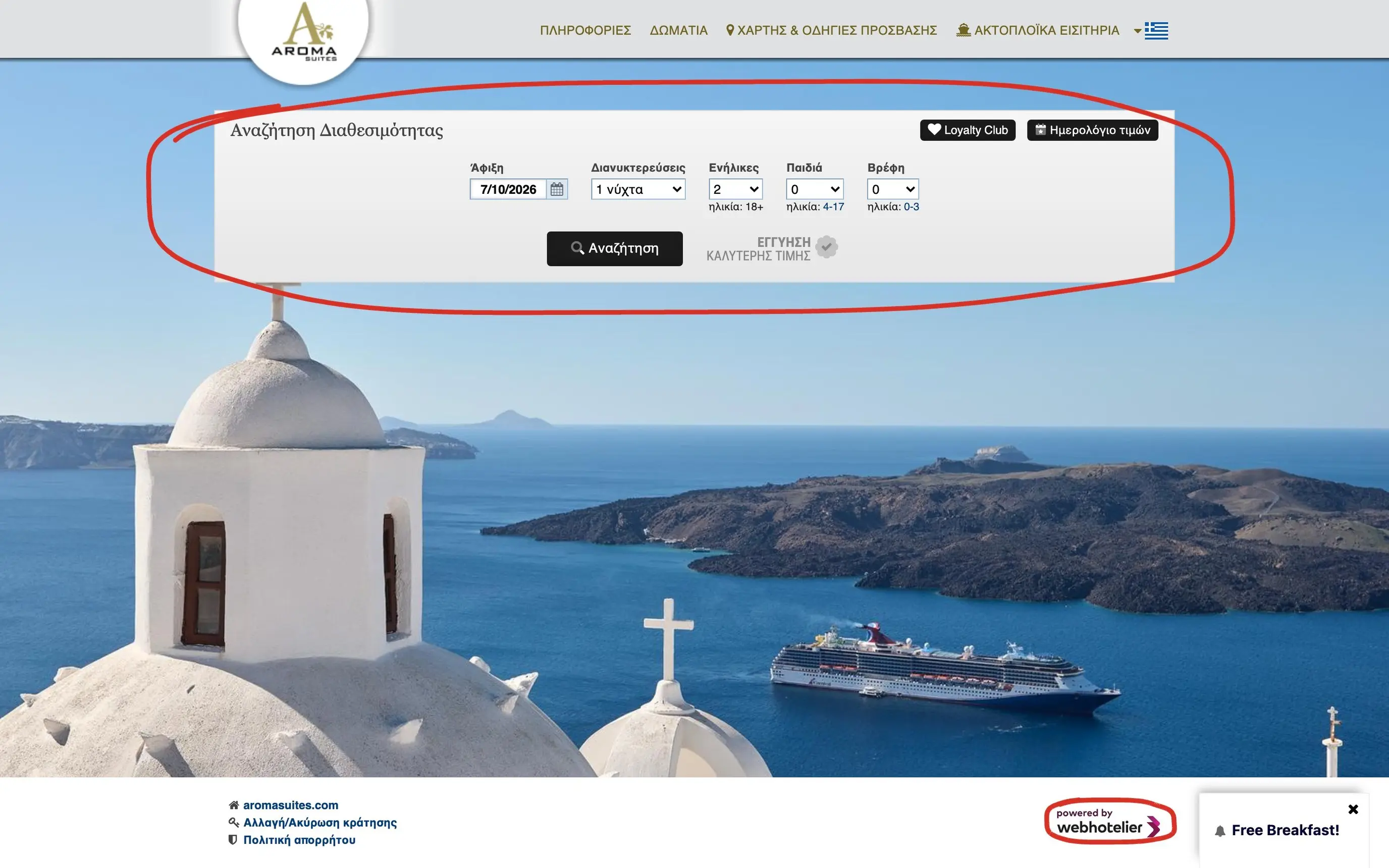 Aroma's booking page, 7 October 2026. The search box is the engine; the "powered by webhotelier" mark at the bottom shows it runs on the vendor's platform, not on the hotel's own site.
What I check on the hand-off:
- The booking button is on every page, at the top, not only on the homepage.
- The engine page looks like the hotel: logo, colours, same language as the page the guest came from. A guest who lands on a page that looks like a different company hesitates.
- The link carries what the guest already chose. If they picked dates or a room on your site, the engine should open with those filled in, not blank.
- Language passes through. A guest reading in Greek should land on a Greek booking page. On a two-language site, I wire this into the same data that drives the language switch.
Tracking: which page sold the room
This is where most hotel sites fail, and where I spend the most time. When the booking happens on another domain, analytics loses the trail unless you set it up on purpose.
On Aroma I did three things. The Aroma case study covers the first two and what GA4 recorded after:
- GA4 cross-domain measurement between the website and the booking engine, so a visit that starts on the site and ends on the engine counts as one journey.
- Tagged booking links. Every booking link carries a label for the button that sent it (header, homepage, footer), so you can see which ones produce bookings.
- A purchase event coming back from the engine into GA4.
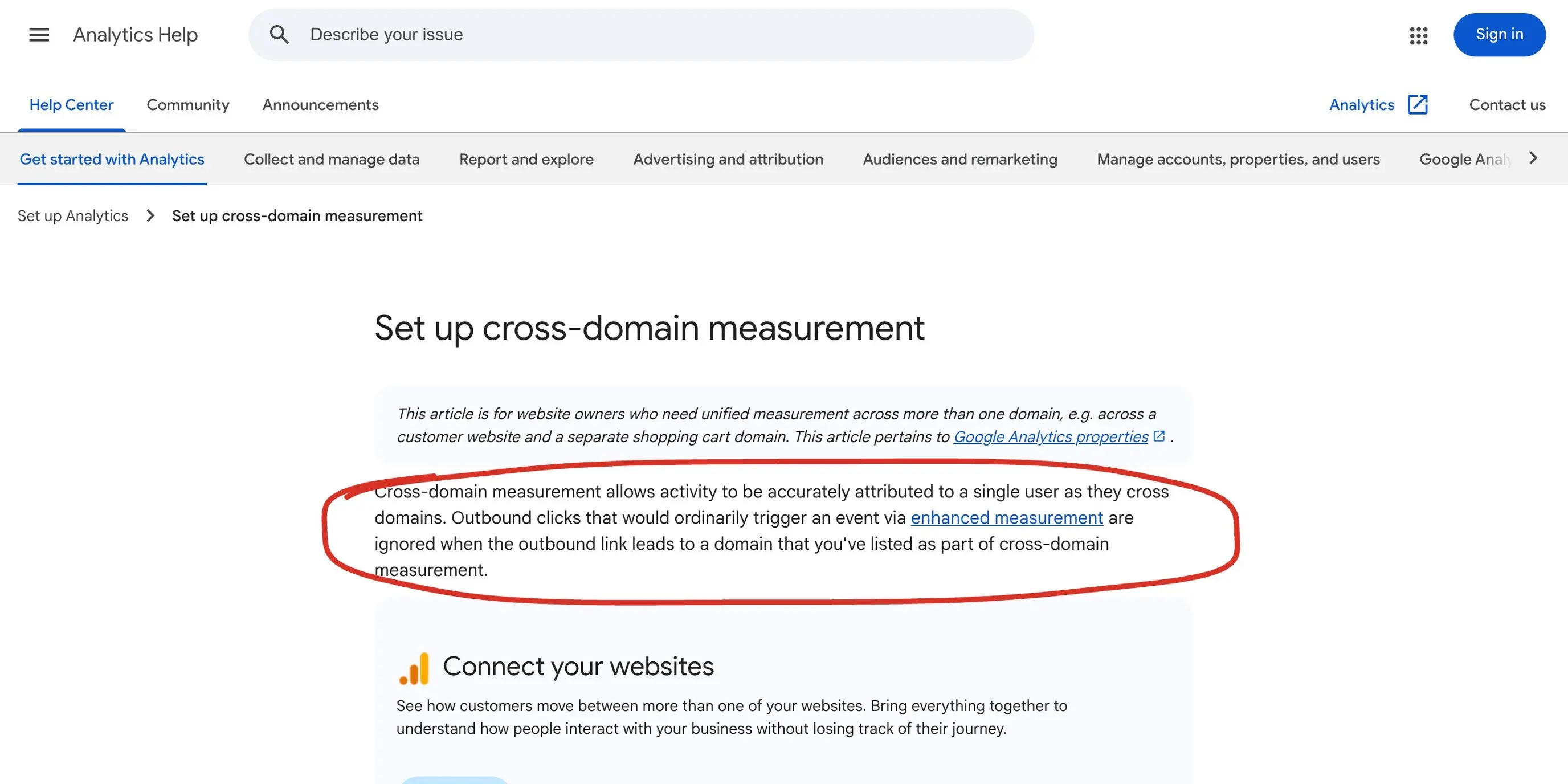 Google's help page for GA4 cross-domain measurement, 7 October 2026. The circled paragraph is the whole point: one guest crossing from your site to the engine is counted as one visit, not two strangers.
Google's own setup steps are in the GA4 cross-domain help page. The engine side depends on the vendor: some let you add your GA4 tag directly, some send purchase data another way. Ask before you sign.
The honest part: analytics is not your ledger
Tracking tells you which pages and buttons lead to bookings. It doesn't tell you how much money came in.
On Aroma, the new site went live at the end of March 2026, and by 17 April the owner confirmed in WebHotelier that it had produced zero direct bookings so far. GA4 recorded the first purchase the next day, and 40 purchase events between 18 April and 22 September 2026, as the case study reports. GA4 doesn't subtract cancellations. So the booking engine stays the real record, and I report the count, not revenue.
My rule for any hotel: use GA4 to compare pages and buttons, and use the engine's own reports for the numbers you'd show your accountant.
What to check before you pick a hotel booking engine
You'll find plenty of vendors. WebHotelier is common in Greece and sells a booking engine alongside a channel manager. International options include SiteMinder and Cloudbeds. I'm not ranking them. Ask each one the same questions:
- Does it connect to your channel manager and PMS without manual updates?
- Can the booking page take your branding and your site's languages?
- Can you pass dates, room and language in the link from your website?
- How does purchase tracking work: GA4 tag on the engine, cross-domain support, or something else?
- What does it charge: a monthly fee, a commission per booking, or both?
- Does it work well on a phone? Book a room yourself on your phone before you sign.
If an engine fails the tracking question, you'll be guessing which marketing works for as long as you use it.
Booking engine, chatbot, or both
A booking engine handles guests who already know what they want. A lot of guests don't: they ask whether the room fits a family of four, how far the beach is, whether there's parking. On Casa di Terra, a private villa in Santorini, an AI assistant on the site answers those questions. I wrote up what that kind of assistant can and can't do in my guide to AI chatbots for hotels.
The engine closes the sale. The site and the assistant get the guest ready to close it.
FAQ
What is a hotel booking engine?
Software linked from your website that shows live availability and rates, takes the reservation and payment, and keeps your rooms in sync with the OTAs through a channel manager.
Is it cheaper for guests to book directly with the hotel?
Often, because the hotel doesn't pay an OTA commission on a direct booking and can offer a better rate or an extra. It depends on each hotel's rate policy and on the OTA contracts it has signed.
Do I need a booking engine if I'm on Booking.com?
If you want direct bookings, yes. Without one, guests who find you on Google have to leave your site to book, often on the same OTA you pay commission to.
Can the booking engine be on my own domain?
Some engines can sit on a subdomain of your site or be embedded. Many run on the vendor's domain. Either works if the hand-off is smooth and cross-domain tracking is set up.
How do I know which page sold a room?
Set up GA4 cross-domain measurement between your site and the engine, tag each booking link with the button that sent it, and send a purchase event from the engine to GA4. Then check the engine's own reports for the actual totals.
Want to see what your booking path loses?
A hotel booking engine is only as good as the path that leads to it. Send me your site and the engine you use. I'll walk the path from a Google search to a confirmed booking and tell you where guests drop off and what isn't being tracked. For budgets, see what a hotel website costs, and for search, hotel SEO. Or get in touch.