AI chatbot development for businesses that answer the same questions every day
AI chatbot development, the way I do it, means building a chat assistant that answers your customers 24/7 from your own documents, in their language, and hands the conversation to a person when it doesn't know. It can sit on your website or on WhatsApp, depending on where your customers ask.
I'm Panagiotis Karampetsos, a developer based in Heraklion, Crete, and I offer AI chatbot development services to businesses in Greece and abroad, working remotely. Chatbots I built are live today on five sites: a skincare e-shop, two hotels, a villa and an environmental NGO. You can open any of them and ask it something. That's the best demo I have.
Prices start from €100 a month for hotels and from €150 a month for e-shops, plus 24% VAT. There's no separate setup fee.
What does an AI chatbot for business do?
It reads a question typed in plain language, finds the answer in the material you gave it, and replies. Your prices, your policies, your opening hours, your product sheets, your PDFs. When the answer isn't in that material, it says so instead of guessing, and points the customer to a person.
Older chatbots were menus: press 1 for prices, press 2 for opening hours. Type anything off-script and they broke. The ones I build run on a large language model (Claude, GPT or Gemini, picked per bot after testing your real questions) and are told to answer only from your content. That rule matters most on things like your refund policy, where a confident wrong answer costs you money.
Most businesses answer the same twenty questions all day, on the phone and in their inbox. Those twenty are the chatbot's job. Anything that needs a judgement call stays with people. I wrote a longer piece on where that line sits: what an AI chatbot for business should and shouldn't answer.
Who builds AI chatbots for businesses in Greece?
I do. My AI chatbot development runs end to end with one person: me, from the first content audit to the widget on your site. Here are the five chatbots I built that are live as I write this. I checked each widget on its site on 15 October 2026.
| Site | Business | What the chatbot does |
|---|---|---|
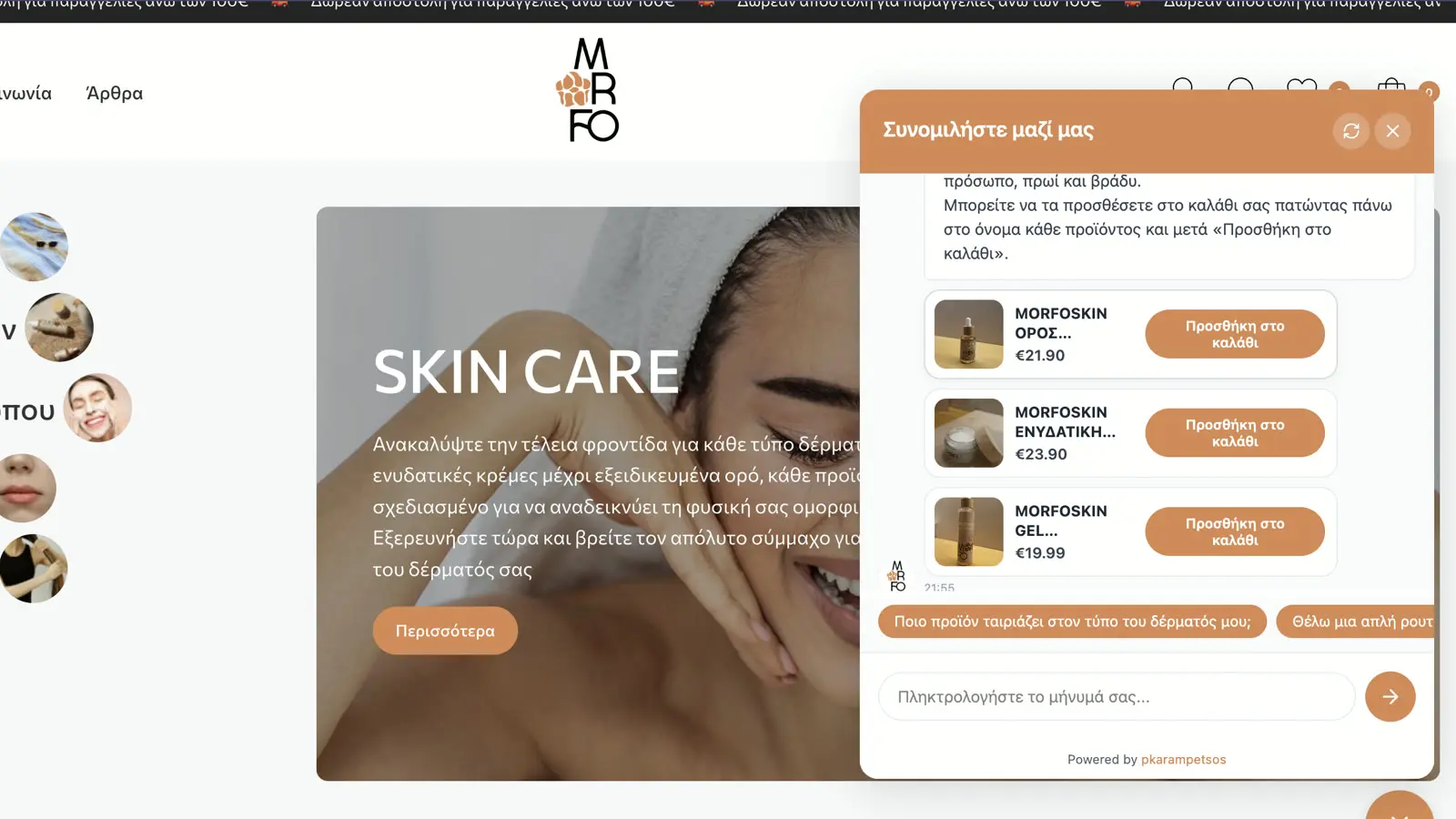
| MorfoSkin | Skincare e-shop on WooCommerce, Greece | Greets customers in Greek. Its suggested questions cover skin type, a morning and evening routine and order updates, and it shows product cards with an add-to-cart button inside the chat |
| Aroma Suites | Hotel, Santorini | Answers about rooms, breakfast and transfers, opens a date picker to check availability inside the chat, then sends the guest to the hotel's own booking engine. Guests can also ask by voice |
| Casa di Terra Villa | Private villa, Santorini | Works as a local guide: what to do, where to eat, where to swim. Asked in Greek, it answers in Greek |
| Amoopi Nymfes Resort | Family resort, Karpathos | Helps families pick a room, answers about the beach and breakfast, and can take a guest's contact details |
| We4all | Environmental NGO, Greece | Answers in Greek about the organisation, how to become a member and what it does |
All five run on Liberators OS, the AI agent platform I built from scratch. I don't resell someone else's chatbot, so when something needs to change, I change the code.
There's a sixth one you can't open, because it's internal. For a fintech company I built an AI assistant for its operations team.
Website or WhatsApp: where should your chatbot live?
Put it where your customers already ask.
- On your website. A chat window in the corner of every page. All five live chatbots above work this way. It's one script, and it runs on WordPress, WooCommerce and custom Next.js sites alike: MorfoSkin, Casa di Terra, Amoopi and We4all are WordPress sites, and Aroma Suites is Next.js.
- On WhatsApp. For businesses whose customers already message them there. I build the WhatsApp chatbot for business on the WhatsApp Business API, on your own number, and it answers from the same knowledge as the website bot. None of my clients runs one live yet, so the five examples above are all website chatbots.
You don't have to pick one forever. The knowledge base is where the work goes, and both channels answer from it.
AI chatbot for hotels
Three of the five live chatbots are on hotel and villa sites. Guests ask the same things at every hotel (check-in time, parking, transfers, breakfast) and they ask late at night, from other time zones. A hotel chatbot answers then, checks availability if your booking engine allows it, and hands the booking to the engine. It never takes payment itself.
Hotel chatbots start from €100 a month, plus VAT. I've written up the hotel side separately: the AI concierge for hotels page covers the website and WhatsApp set-up for hotels, and my hotel chatbot guide covers what they cost, SaaS against custom, and what broke on a live hotel site.
AI chatbot for e-shops: product questions, orders and returns
An e-shop gets three kinds of question: "which product is right for me?", "where's my order?" and "how do I return this?".
The first one is where a chatbot earns its keep. On MorfoSkin a customer asks which product suits their skin type, and the assistant answers with the matching products as cards in the chat, each with an add-to-cart button. The customer doesn't have to search the catalogue or leave the conversation.
Returns and shipping questions get answered from your own policy pages, in the words you wrote. For order status, the bot sends the customer to their order page or their order confirmation email. It doesn't look orders up itself.
E-shop chatbots start from €150 a month, plus VAT.
An AI assistant for your team: the company knowledge base
Not every chatbot faces customers. The same build works inside a company: your team asks a question in plain language and gets the answer from your own manuals, procedures and documents, instead of asking the one colleague who knows. The fintech assistant above is this kind.
Internal assistants are priced per project, because the work depends on how many documents there are and which systems the assistant has to read. If your problem is bigger than questions and answers, like documents that need sorting or data that needs moving between systems, that's AI automation, and I cover it on my AI automation consultant page.
What happens when the chatbot doesn't know the answer?
It says so. Then it gives the customer a way to reach a person. That behaviour is written into the bot's instructions and tested before launch, because a bot that invents an answer is worse than no bot.
How the handoff works depends on your business. Today my chatbots send the customer to your phone, email or contact form. On Aroma Suites the chat window carries the hotel's phone and email, so a guest reaches the front desk in one tap. On Amoopi Nymfes the bot can take the guest's details for the resort to reply. If you want your staff to take over a conversation inside the chat window, I can switch on live chat, because the platform supports it.
Words like "refund", "complaint" or "speak to a person" should skip the bot. I'd rather your customer reached a person one message early than one message late.
How does AI chatbot development work, step by step?
In seven steps, and most of the work happens before any code: getting your content right decides how good the answers are.
- Content audit. I read your site and your documents and list every fact the bot will need. Anything missing gets written before the bot exists, because a bot with thin content gives thin answers.
- Connections check. Can your booking engine or shop share availability or products? So far I've connected Reserve-Online, the booking engine on Aroma Suites, and the WooCommerce cart on MorfoSkin. If yours can't, the bot answers questions and links to the right page. You hear that before we start.
- Instructions. Tone, languages, what it refuses, when it hands off, and what it says when it doesn't know.
- Knowledge. Your documents get uploaded and your site gets crawled into the bot's knowledge base.
- Testing. I throw real conversations at it: off-topic questions, language switches, angry customers, attempts to make it ignore its instructions. Every failure goes back into the instructions or the content.
- Launch. It's labelled as an AI assistant, the script gets embedded, and I check that your site's speed and security settings still hold, because chat widgets slow pages down and get blocked by security headers if nobody checks.
- After launch. In the first weeks I read the conversations and fix what the bot got wrong. After that, when your prices or policies change, you tell me and the bot changes with them.
Once your material is in, the chatbot is live in 1 to 2 days.
How much does AI chatbot development cost?
A chatbot for a hotel starts at €100 a month and one for an e-shop at €150 a month, before VAT. An internal assistant gets its own quote.
| Chatbot | From | With 24% VAT |
|---|---|---|
| Chatbot for hotels | €100 a month | €124 a month |
| Chatbot for e-shops | €150 a month | €186 a month |
| Internal assistant for your team | quote after a short call |
Prices are ex VAT, and the VAT column is my own arithmetic at the Greek 24% rate. The final price depends on how much content the bot has to learn and which systems it connects to.
The monthly price covers the setup, with no separate fee. It also covers AI usage with no cap on conversations, changes to answers, prices and documents when you ask for them, and a monthly report on what customers asked.
What a chatbot shouldn't do
I won't set a chatbot up to take payments, to argue with an unhappy customer, or to decide a refund. Payment belongs in your booking engine or checkout, which are built for it. Complaints and refunds need a person who can fix things.
I also won't promise a chatbot will double your sales. What I can tell you after reading your inbox is which questions a bot would take off your desk, and whether that's worth the monthly price.
FAQ
How much does an AI chatbot cost per month?
It's a monthly price: hotels from €100 and e-shops from €150, with 24% VAT on top. For an internal assistant I send a quote, because the price depends on your documents and systems.
What languages does the chatbot speak?
It replies in the language the customer writes in, without separate setup per language. Ask the Casa di Terra bot in Greek and it answers in Greek. Before launch I test the languages your customers use, because a policy that reads fine in English can come out wrong in another language.
What happens if the chatbot doesn't know the answer?
It says it doesn't know and points the customer to a person, by phone, email or your contact form. It's told to answer only from your content, so it doesn't fill gaps by guessing.
Is an AI chatbot GDPR compliant, and does the EU AI Act apply?
The EU AI Act's Article 50 requires AI systems that talk directly to people to tell them they're talking to an AI, unless it's obvious. The chatbot's first message should say it's an AI assistant, and that's on my launch checklist. Chat conversations are personal data under the GDPR, so your privacy policy needs to mention the chatbot. The conversations are stored on servers in the EU, and I sign a data processing agreement (DPA) with you if you ask for one.
How long does it take to set up an AI chatbot?
1 to 2 days after I have your material. Most of the time goes into the content, not the code. If your FAQs and policies are already written down, it's faster.
Should my chatbot be on the website or on WhatsApp?
Wherever your customers already ask. If they find you through Google, start with the website. If they already message you on WhatsApp, add it there. Both answer from one knowledge base, so adding the second channel later doesn't mean starting over.
Can the chatbot take bookings or orders?
It can move them forward without closing them. On Aroma Suites the guest picks dates inside the chat and goes to the hotel's booking engine to book. On MorfoSkin the customer adds products to the cart from the chat and pays at the normal checkout. Nobody pays inside the chat.
Do I need a new website to add a chatbot?
No. The chatbot is one script added to your existing site. The five live ones run on WordPress, WooCommerce and Next.js sites. I do check your site's security headers and page speed after adding it.
Let's see what your customers keep asking
Send me your website and the five questions you answer most often, and we'll see whether AI chatbot development makes sense for you. I'll tell you which of those questions a bot would take off your desk, which channel I'd start with, and what it would cost.