App development in Greece, from the first screen to the App Store
App development in Greece, done by one person: the iOS and Android app, the backend it talks to, the website next to it and the release in both stores. I'm Panagiotis Karampetsos, a developer based in Heraklion, Crete, and I work remotely with businesses across Greece and abroad.
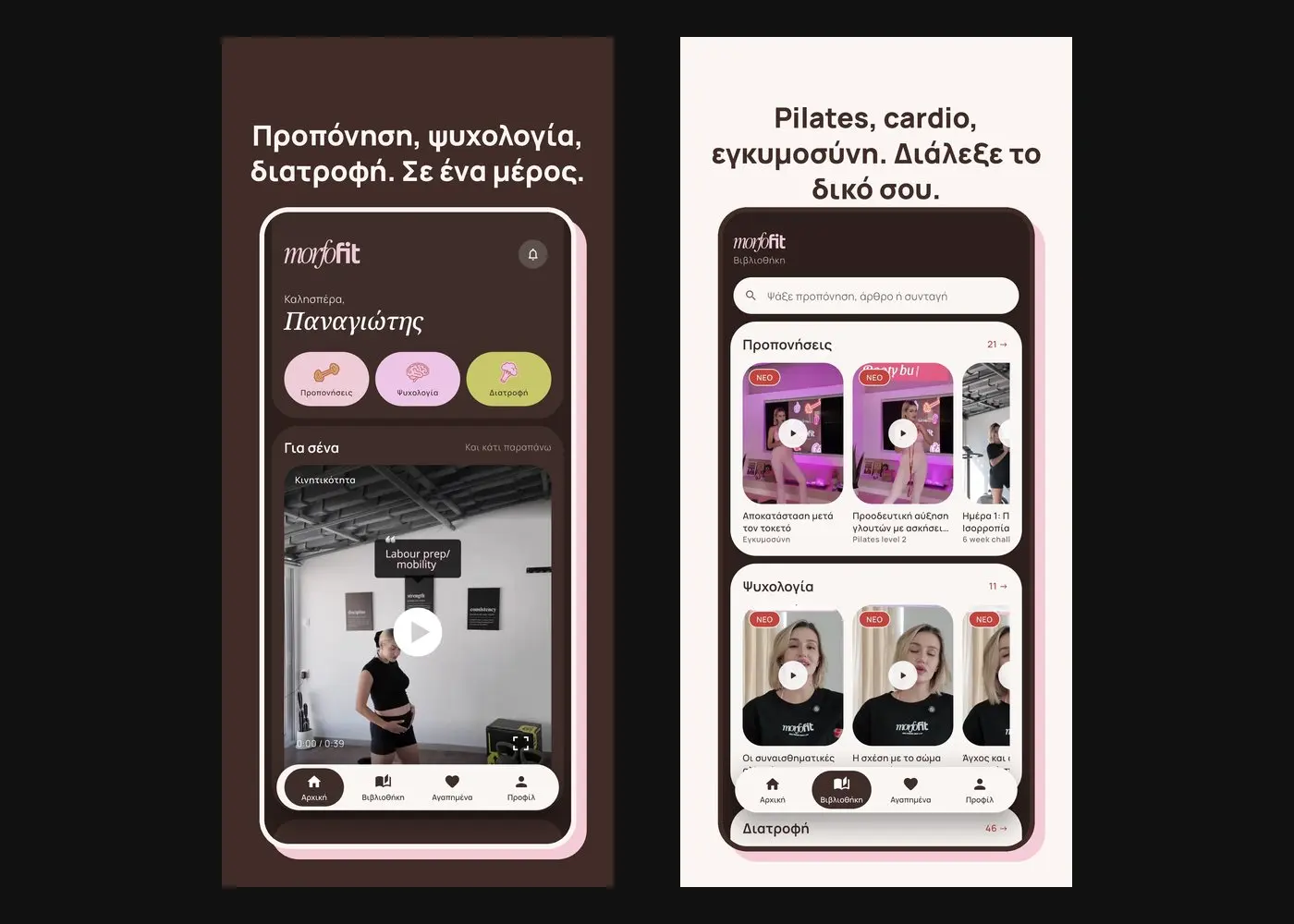
My most recent app is MorfoFit, Elena Magoula's home workout subscription for women. It's live on the App Store and on Google Play, and subscribers use the same account on the app and on the website.
App development starts from €4,000, plus 24% VAT. You get the final price after a call, once I know what the app has to do.
What I build
An app on its own is rarely the whole job. For MorfoFit I worked on four pieces that have to agree with each other:
- The app, for iOS and Android. One Flutter codebase that ships to both stores. Video playback, favourites, search, reminders and push notifications.
- The backend. Accounts, subscriptions and content live on the server, so the app and the website show the same thing.
- The payments. In the app, Apple and Google take the payment. On the website, a card processor does. The server checks each store receipt before it opens access, and every subscription lands in one table.
- The admin panel. The client uploads videos and recipes and schedules them without calling me. New material shows up in the app on its own.
If your business needs a mobile app development partner who also builds the website and the payments behind it, that's the kind of job I take.
A real app: MorfoFit, on both stores
MorfoFit is a subscription with a video library of Pilates and cardio, programmes for pregnancy and after birth, recipes and short psychology videos. Elena publishes it under her own developer account: the App Store lists her as the seller.
When I started on 30 July 2026, an Express backend and a Flutter app already existed, written by another developer. The app wasn't in any store. I reviewed the code first and fixed what needed fixing. I built the website, the payments and the admin. On 10 September I took over all the app work: push notifications, Greek on every screen, and a paywall that shows the price the store returns. Apple approved the app on 15 September, and it went public on Google Play on 22 September 2026. Its App Store release date is 25 September 2026, and the current version came out on 2 October 2026.
What the app does today, from its store listing:
- A video library you can search, with a "continue where you stopped" on every workout.
- Favourites across workouts, recipes and articles.
- Workout and meal reminders on the days and times you choose. They run on the phone, without an internet connection.
- A weekly progress notification every Sunday, and a notification when new material goes up.
- Three subscription plans, monthly, six-month and yearly, with the price shown in the app in your own currency.
The videos are protected on the server. In August I moved all 56 videos that existed then to encrypted streaming with a link signed for each request, so the file doesn't open if someone copies the address. The full story, with every date, is in the fitness app development case study.
In development: Japan Quest, an AI trip planner
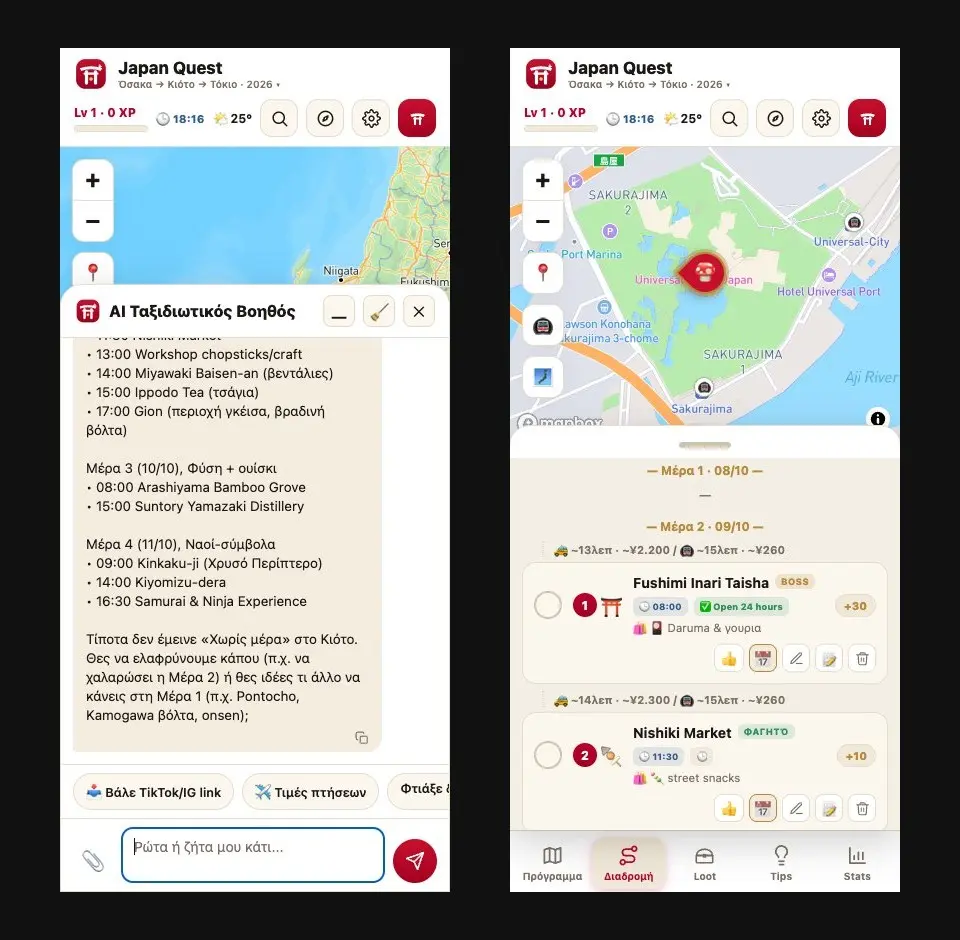
Japan Quest is the app I'm building now. It isn't released yet: it's in beta testing on Apple's TestFlight, not in the App Store or Google Play.
It plans a trip to Japan on a map. You tell the AI assistant in the chat what you want, and it adds places, builds the programme day by day and changes it when you ask. A day planner spreads the places over the days by distance, keeps lunch and dinner at normal hours, and the route shows each day with times.
It's written in React Native with Expo, so one codebase runs on iOS, Android and the web. Trips are stored on Supabase, so friends can share one trip, and the screens come in Greek, English and Japanese.
Flutter app development: one codebase, two stores
The MorfoFit app is written in Flutter, Google's toolkit that builds iOS and Android apps from one codebase. In mobile app development for a small business, that matters for one reason: you pay for one app, not two, and a change goes out to both stores together.
Japan Quest uses React Native with Expo instead, which also builds the web version from the same code. I pick per project. Both give you one app, not two.
It's not free of trade-offs. Store rules, payments and notifications still differ between Apple and Google, and each needs its own setup and testing. The shared code covers the screens and the logic, not the paperwork.
Do you need an app, or is a website enough?
For most businesses, start with a website. An app earns its place when your customers come back often: a workout library, bookings they repeat, an account they check every week. Then notifications and a home-screen icon pay off.
An app also brings the stores' rules. If you sell digital content, the app has to offer it as an in-app purchase. Apple's App Review Guidelines, section 3.1.3(b) let an app open content the customer bought on your website, as long as the same items are also on sale inside the app. That's how MorfoFit works: buy on the site, or in either store, and the same account opens the app.
So my advice runs against the trend: if a website does the job, build the website. I'd rather build you a good site than an app nobody opens twice.
Already have an app someone else started?
That's how MorfoFit came to me. Before I write a line, I read what's there: how the app talks to the server, how payments and logins work, what breaks. You get my findings and a proposal before any work starts. MorfoFit started this way, with a code review on the first day.
Then we decide together whether to finish it or rebuild parts of it. With MorfoFit, the existing app was a usable base, so I finished it and took it through both stores.
The store part nobody budgets for
Writing the code is half of it. The other half happens in the stores, and it's slower than people expect:
- The app goes out under your own Apple and Google developer accounts, so it stays yours.
- Apple asks every developer to declare a trader status under the EU Digital Services Act to distribute in the EU. At MorfoFit, that verification took longer than all the app work. So I start it the day the developer account opens.
- Both stores review the app before it goes public, and again with every update. Screenshots, descriptions, privacy details and a test account for the reviewer are part of the job.
- In-app products, prices and receipts have to be set up in each store, and checked on your server through Google Play Billing and Apple's own system.
I handle all of this. You approve the store texts and sign what only the account owner can sign.
How much does app development cost?
App development starts from €4,000, plus 24% Greek VAT (€4,960 with VAT). There's no fixed upper limit, because a simple app that shows content and an app with subscriptions, video protection and a website behind it aren't the same job. You get the final price after a call.
To quote, I need to know:
- What the app does, in a few sentences.
- Who pays, how, and for what: one-off, subscription or nothing at all.
- What exists already: a website, a backend, half an app.
- Who adds content after launch, and how often.
If your app sells to customers in Greece and needs receipts in myDATA, I can also build the myDATA API integration for it.
One developer or an agency?
If you're looking for an app developer in Greece rather than an agency, here's the difference: the person who scopes the app is the person who writes it and sends it to the stores. Nothing gets lost between a sales call and a development team.
The trade-off is capacity. I'm one person, so I take on fewer projects at a time than an agency, and I'll tell you up front if I can't fit yours in. More of my work is on the portfolio page, and the rest of my services are on the services page.
FAQ
How much does app development cost in Greece?
With me, app development starts from €4,000 plus 24% VAT. You get the final price after a call, once I know what the app does, how it takes payments and what exists already, because the range between a content app and a subscription platform is wide.
Do you build apps for both iOS and Android?
Yes. MorfoFit is one Flutter codebase, released on the App Store and on Google Play. Japan Quest, still in development, is React Native with Expo and also runs on the web.
How long does it take to build an app?
It depends on what exists. At MorfoFit the whole project, website and payments included, ran from 30 July to 22 September 2026, with my part of the app, store release included, in the last two weeks.
Can you finish an app another developer started?
Yes. MorfoFit's app existed when I took it on. I review the code first, write down what I'd fix, and then finish and release it.
Can customers pay on my website and use the app?
Yes, if the app also sells the same subscription as an in-app purchase, as Apple's guidelines require. MorfoFit works this way: one account, three places to pay.
Whose developer account is the app published under?
Yours. MorfoFit is published under Elena's own account, and the App Store shows her as the seller.
Do you work with clients outside Greece?
Yes. I work remotely, in Greek or English, and clients abroad work with me the same way as clients in Athens or Heraklion.
Tell me about the app
Tell me what the app should do, who it's for, how it takes payments and what exists today. I'll tell you whether you need an app at all, and if you do, what it would take.
Or write directly to me@pkarampetsos.com