Maritime AI for shipping companies, built on your vessels' own documents
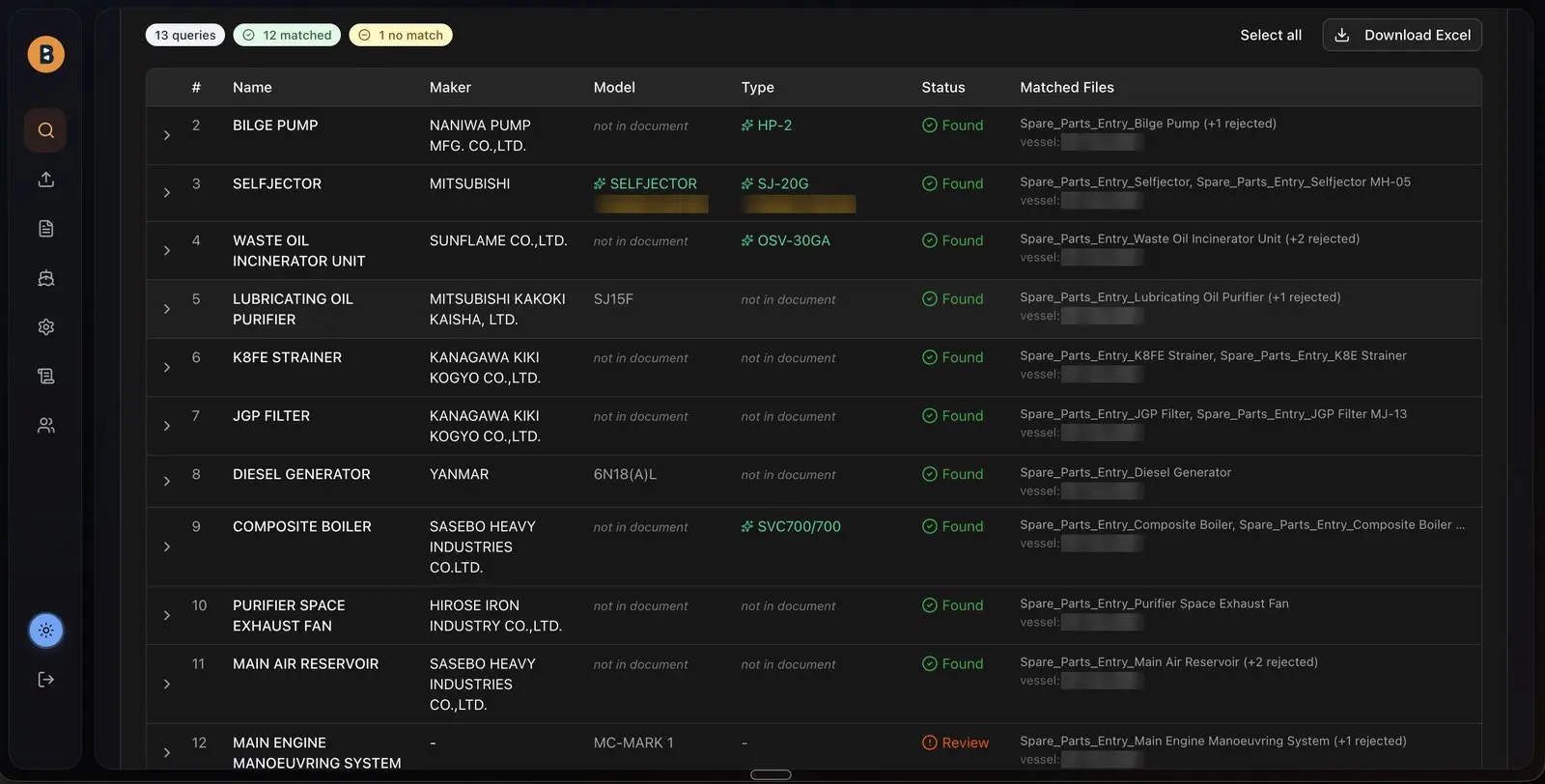
Maritime AI, the way I build it, is software that reads a vessel's manuals and equipment registers and does the document work your technical team does by hand today: filling templates, finding the right page, checking a value against its source. It doesn't steer the ship. It handles the paperwork about the ship.
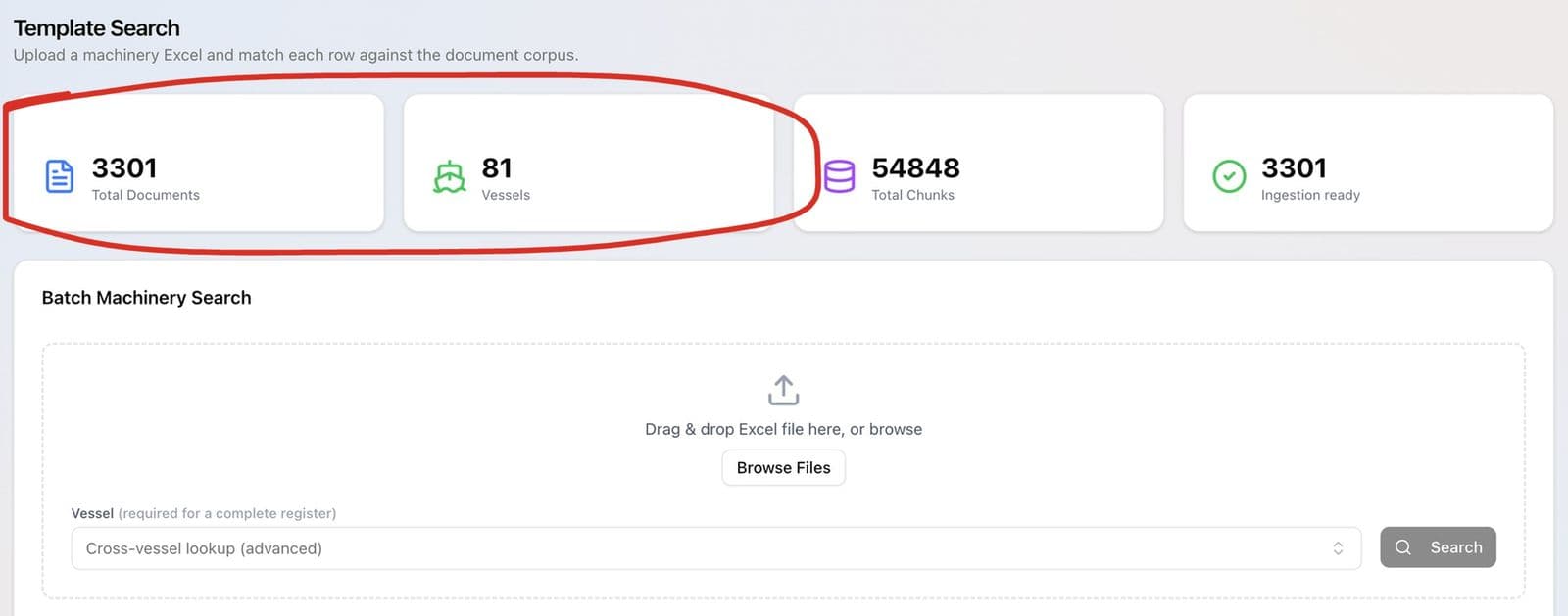
I'm Panagiotis Karampetsos, a developer and AI automation consultant based in Heraklion, Crete. I work remotely, in Greek and English, so it makes no difference whether your office is in Piraeus, Athens or abroad. My main maritime project is a template matching system I built for Benefit, the Piraeus company that makes ERP software for the shipping industry. It searches 3,301 documents across 81 vessels.
I don't publish a price for this work. Every fleet's documents are different, so you get a quote after a call.
How is AI used in shipping companies?
Most of what you read about AI in shipping is about the ship at sea: route planning, fuel use, vessel tracking, predictive maintenance on engines. That work is real, and it's done by companies with sensors on board and data scientists on staff.
I work on the other half, the office. A shipping company runs on documents: maker manuals, equipment registers, spare parts lists, certificates, Excel templates that someone has to fill in for every vessel. The answer to most questions already sits in one of those files. Finding it is the slow part.
That's where I think artificial intelligence in shipping pays off soonest. Nothing new goes on board. The software reads what you already have and points to the exact place it found each answer.
Can AI fill vessel equipment templates from the ship's manuals?
Yes. That's what the system I built for Benefit does. Benefit builds ERP software for shipping companies, and their team needed machinery templates filled from each vessel's documents. Here's the flow:
- Upload the template. Someone uploads the vessel's machinery Excel template. Its rows list the equipment to fill: name of machinery, maker, model, type.
- Search that vessel's documents. For each item, the system searches that vessel's manuals and equipment registers. This uses RAG (retrieval-augmented generation): the AI first retrieves the relevant passages from your own files, then answers only from them (AWS explains RAG here).
- Match and fill. Each item it can match goes into the template's cells, with the source file and the row it came from next to the value.
- List what it rejected. Items it couldn't match with confidence go on a separate list, each with the reason: the name didn't match, the maker was blank, the model pointed to a different unit.
A second check runs before a value is kept. One maker often supplies several parts on the same ship, the propeller and the bow thruster for example. So the AI re-reads the paragraph each value came from and confirms it belongs to this piece of equipment, not to its neighbour from the same maker. If it doesn't, the value is dropped.
It isn't a chatbot. Nobody types questions into it. The template goes in, and the filled template comes out with its sources.
Why does a source on every cell matter to a technical team?
Because a superintendent can't sign off on a value they can't check. If the AI fills a cell with a model number, the next question is always "where did that come from?" With the source file and row next to it, the answer takes one click instead of a search through a folder of PDFs.
It also gives you an audit trail for inspections and compliance reviews. Six months later, when someone asks why the register says what it says, the source is still there.
And it changes what an empty cell means. I'd rather the system leave a cell blank and tell you why than fill it with a confident guess. A wrong value in a machinery register is worse than a missing one, because nobody goes looking for it.
What else can maritime AI do with ship manuals?
Templates are one job. Here are three more I build: two I've already built for other industries, and one that's still a pilot.
Ask the manual, get the step and the picture. An engineer or a member of the crew asks a question about a piece of equipment. The AI answers with the steps from the maker's manual ("check X, then unscrew Y") and shows the photo or drawing from that manual with the part circled. This is a pilot I'm building, not a delivered system, so I'd show it to you on a call rather than point you to a ship that uses it. Because the engineer talks to an AI, they should know it's an AI. The EU AI Act sets that out in Article 50.
Read scanned paperwork. For a Greek supermarket chain with 175 stores, I built a pipeline that reads more than 100,000 documents a month, delivery notes and invoices among them, with the stamps on the scans read by a vision model. Delivery notes and spare parts paperwork in a shipping office are a similar problem: paper that has to become data you can check.
Answer from your own documents, with citations. My own platform, Liberators OS, runs AI assistants that answer from a company's files and show where each answer came from. For a shipping office, that could be your procedures, circulars or the vessel files.
More examples across industries are in what AI automation looks like in practice. If you're weighing where to start, my AI implementation guide walks through it step by step.
What does maritime AI cost?
There's no list price. You get a quote after a call. The cost depends on how many vessels are in your fleet, what state the documents are in (searchable PDFs and Excel are faster than scans), and what the output has to look like.
On the call I ask for one real template and the documents for one vessel. I tell you what I think the system can match, what it probably can't, and what a first version would cost. If AI isn't the right tool for your problem, I'll say so.
What I won't claim
I'm not listing integrations with planned maintenance systems on this page. The Benefit system works through an Excel upload and an Excel download. Whether I can connect to your software depends on whether it has an API, and that's a question for the call.
I'm not a class society, and nothing I build replaces your safety management system. I also don't quote you time saved per template. I haven't measured it on your documents, and a number I can't back up is no help to you.
FAQ
Is this a chatbot?
No. The template matching system has no chat. You upload an Excel template, and it returns the same template filled, with a source for each value and a list of rejected items. The manual assistant I'm piloting is the conversational part, and it's a separate build.
What documents can AI for shipping companies read?
Searchable PDFs and Excel registers can be read directly. Scanned pages need OCR first. Before I promise anything on scans, I test the OCR on a sample of your own documents, because old maker manuals vary a lot in quality.
What happens when the AI can't find a value?
It leaves the cell empty and puts the item on the rejected list with the reason. Your team sees exactly which rows still need a person, instead of discovering a bad value later.
Does maritime AI replace our PMS or ISM documentation?
No. It works next to them. The ISM Code from the International Maritime Organization requires a safety management system, and that stays yours. What I build reads documents and fills templates that your team reviews.
Can it connect to our maritime software?
It depends on your software. If it has an API, I can look at connecting to it directly. If it doesn't, Excel in and Excel out works today, as it does for Benefit.
Who sees our vessel documents?
Only the services the system needs to run, and I tell you which ones before any document goes in. Some AI providers train on data by default unless you opt out, so I check each provider's terms for your project and put the answer in writing.
Do you work with shipping companies in Piraeus?
Yes, remotely. Benefit's office is in Piraeus, and I work with them from Heraklion, Crete. The same goes for companies in Athens or abroad, in Greek or English.
How much does it cost?
You get a quote after a call. It depends on the number of vessels, the state of the documents and what the output needs to look like. I don't publish a price because two fleets rarely need the same build.
Send me one template and one vessel's documents
The quickest way to see if maritime AI fits your team is to try it on a real file. Send me one template you fill by hand today, and tell me where its answers live. I'll tell you what the system could match, what it couldn't, and what it would take to build. For the wider service, see my work as an AI automation consultant.