Hotel Chatbot Guide (2026): What It Does, What It Costs, Real Examples
What a hotel chatbot does and costs, six hotel chatbot tools compared on published price, and three live examples on hotel sites, with where each stops.
Short answer
A hotel chatbot is a chat window on your hotel's website (or WhatsApp) that answers guest questions for you at any hour: check-in times, parking, transfers, which room fits a family. A modern one runs on a large language model, reads only your own hotel content, sends guests to your booking engine with their dates filled in, and hands anything difficult to a person. Published SaaS plans start around €99 a month, and a custom hotel chatbot like the ones I build starts at €100 a month plus VAT.
- What it's good at: repeat questions, pre-booking questions, sending guests to your own booking engine, and answering in the guest's language at 2 a.m.
- What it's bad at: refunds, complaints, booking changes, anything that needs a judgement call. Those go to a human.
- What it costs: according to HiJiffy's pricing page, its plans start at €99, €159 and €319 a month plus a setup fee. Several vendors publish no price. The comparison table covers six, checked 17 October 2026.
- The EU rule: since 2 August 2026 the AI Act requires that people know they're talking to an AI system. Label the bot.
I build these. Hotel chatbots I set up are live on Aroma Suites, Casa di Terra Villa and Amoopi Nymfes (widgets checked on all three on 17 October 2026). They run on os.liberators.ai, the agent platform I built and use for every chatbot I deploy. This guide is what that work taught me, including the parts that went wrong.
What a hotel chatbot does day to day
Answers the same ten questions. Check-in time, parking, breakfast hours, cancellation policy, pets, children, airport transfers. A bot grounded in your own content answers them the same way every time.
Gets the guest to the booking engine. "Do you have a room for 12 to 15 May for two adults?" The bot's job is to move that guest to your own engine with the dates already in, so the question gets answered on your site instead of on an OTA. More on what a booking chatbot can and can't do further down.
Works as a local guide. "Where should we eat tonight?" Give it a list of places you'd send your own friends and it becomes a concierge that doesn't clock out. Keep that list current. A bot that recommends a closed restaurant makes the whole hotel look careless.
Covers the night shift. Guests plan trips late in the evening and from other time zones. The hotel chatbot answers then, and the front desk reads the transcripts in the morning.
Speaks the guest's language. Current language models reply in the language the guest writes in, with no setup per language. Test the languages your guests use anyway. A policy that reads fine in English can come out wrong in German.
Hotel chatbot examples: three live hotel sites
The fastest way to understand a hotel chatbot is to use one. These three run on the same platform, each with its own look, knowledge base and job.
Aroma Suites, Fira, Santorini. A cave hotel with six room types and a villa. The chatbot offers quick replies for rooms, breakfast, location and transfers, can show room photos in its answers, and takes voice questions. When a guest wants to book, a date picker opens inside the chat and passes the dates to the hotel's booking engine, Reserve-Online. A "Contact reception" button gives the hotel's phone and email in one tap. I also built the site it sits on, and the Aroma Suites case study covers that side.
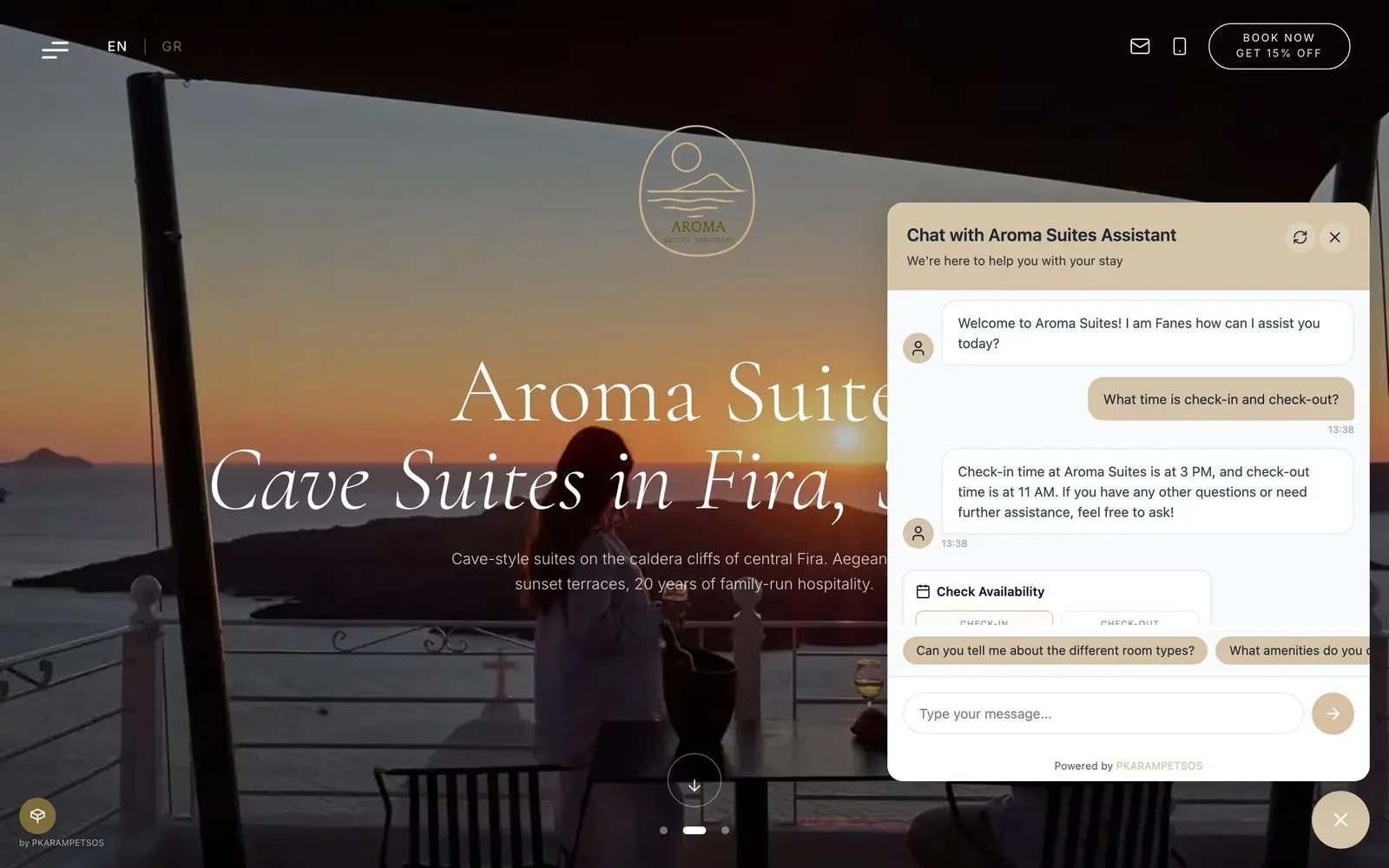 The availability panel opens inside the conversation, under the answer, so the guest picks dates without leaving the chat.
Casa di Terra Villa, Santorini. A private villa with the same owner as Aroma. Its chatbot is set up as a local guide: the suggested questions are about what to do, what to visit, where to eat and where to swim.
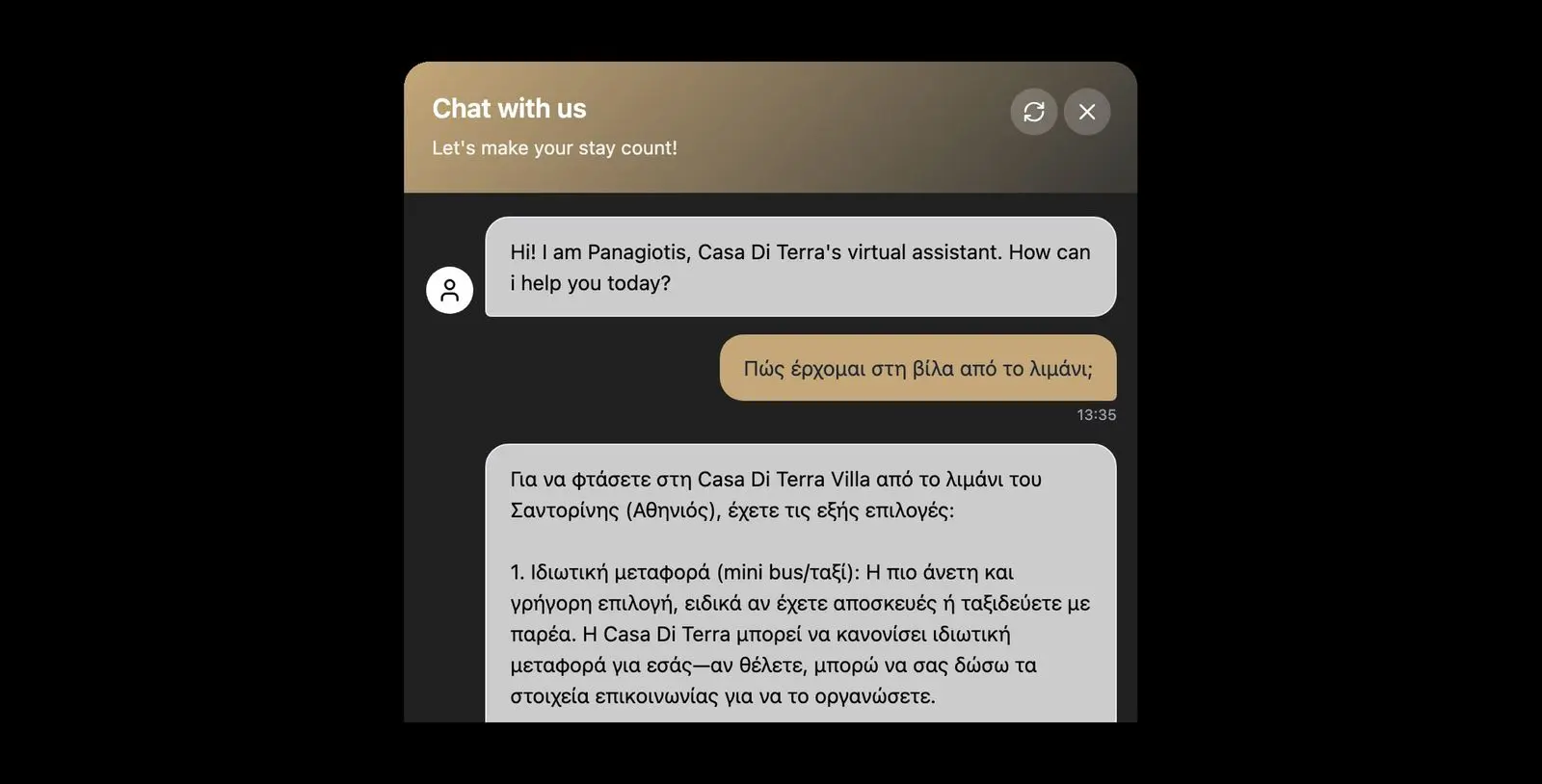 Asked in Greek, answered in Greek. The port and the private transfer come from what the villa gave the bot, not from the model's general knowledge.
Amoopi Nymfes, Karpathos. A resort, with a chatbot in its own blue. The suggested questions ask which room suits a family, whether there's a beach nearby and whether breakfast is included. When a guest wants a reply from the team, a short form takes their name and email.
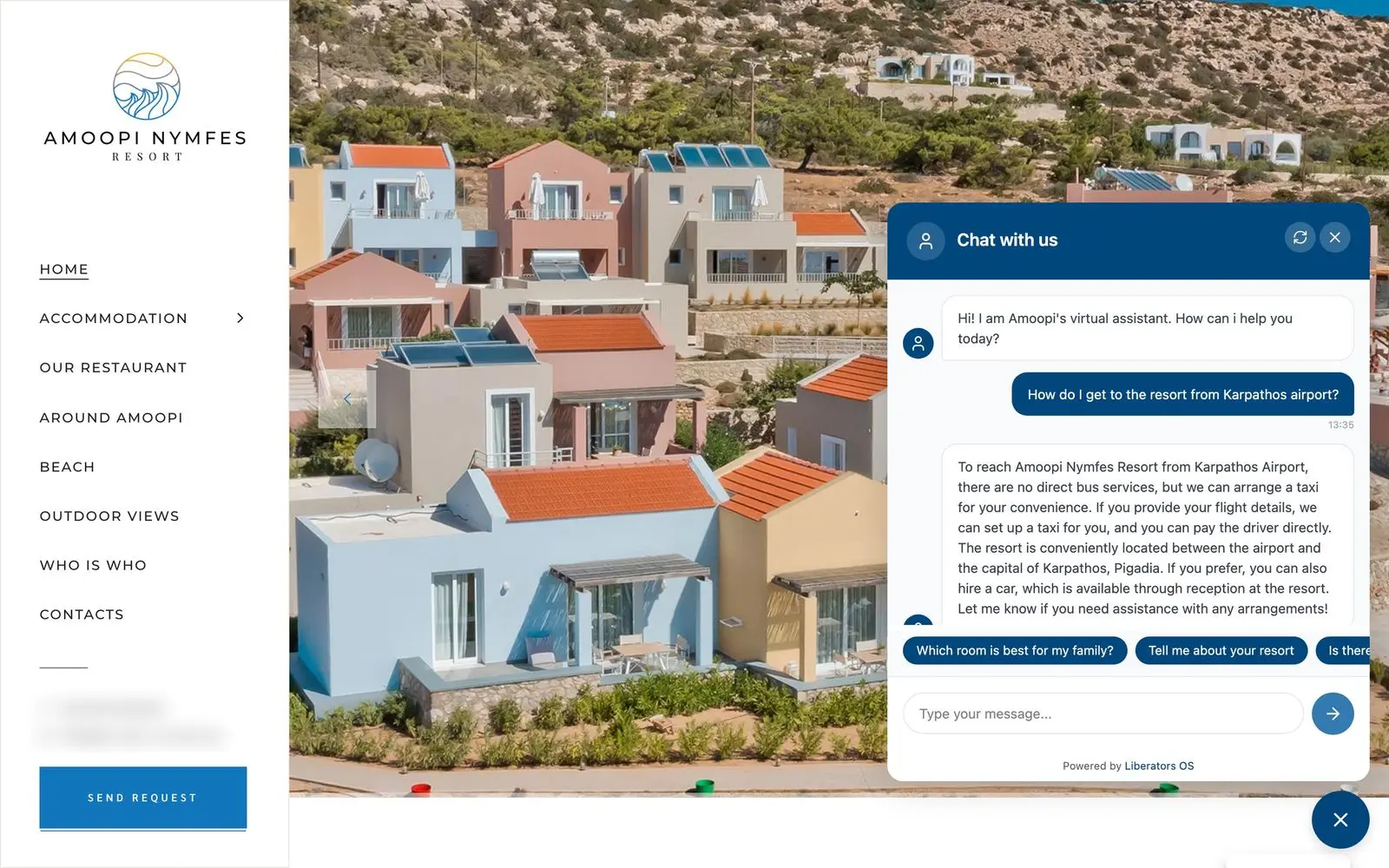 Same platform as the Aroma Suites bot, with its own colours, its own suggested questions and its own answers about Karpathos.
Three properties, three jobs: one moves guests toward booking, one is a guide, one collects questions for the team. Decide the bot's job before you pick the tool.
Can a hotel booking chatbot take reservations?
Partly. A hotel booking chatbot can do the part of the booking that's conversation. The transaction belongs to your booking engine.
What a booking chatbot can do:
- Answer the questions that stop people booking: cancellation terms, what's included, which room fits two adults and a child.
- Collect dates in the chat and open your booking engine with them pre-filled. On Aroma, the dates picked in the chat go straight to Reserve-Online.
- Check live availability, but only if your booking engine exposes it to outside tools through an API or MCP.
- Collect the basics for groups, weddings and long stays, then pass them to a person.
What it shouldn't do:
- Take payment. The booking engine is built for secure payments, and the guest expects that step. I don't set bots up to take cards.
- Change or cancel bookings. "Swap my junior suite for the villa on the first night and split the payment across two cards" goes to a person.
- Guess availability. If the bot can't reach the engine, it sends the guest to the booking page. It never says "yes, we have that room" from memory.
Check your engine before you pay for anything. Not every hotel booking engine exposes availability. If yours has no API, find out whether it supports a booking link with dates in it. If it has neither, the bot answers questions and hands over, and you should know that on day one. The only booking engine integration I run in production today is Reserve-Online, on Aroma Suites.
Where hotel chatbots break
Push a hotel chatbot past what it's built for and it fails in front of your guests.
Money going the wrong way. Refunds and disputes need a person. A bot saying "I understand your frustration" to someone who wants their money back reads like a wall.
Real complaints. Cold room, dirty bathroom, loud neighbours. The guest needs someone who can fix it. The bot's job is to spot the complaint, apologise once and get a human in fast.
Judgement calls. Comp the night? Move them upstairs? Is this a regular? Those are commercial decisions. Keep them human.
A hotel chatbot that tries to handle all of this does more damage than having none. Most of the skill is deciding where it stops.
How an AI hotel chatbot works
Four parts. Everything else is plumbing. A bot built this way isn't the same as ChatGPT on its own, which doesn't know your check-in time; I cover where that stops in ChatGPT for small business.
1. The language model. The practical choices in 2026 are Claude, OpenAI's GPT models and Google's Gemini. All three can do this job. My platform lets me pick the model per bot, so I test the hotel's real questions on more than one. For small boutique properties I usually land on Claude, because it sticks to instructions and its default tone is calmer. That's my preference from testing, not a benchmark.
2. Grounding: your content. The model knows nothing about your hotel. Everything it says about rooms, policies and the area comes from what you give it: the website, room descriptions, policies, FAQs, local tips, uploaded documents. If your content is thin, the bot is thin. If your content is wrong, the bot is wrong, only faster and in more languages.
3. The booking engine connection. The API, MCP or pre-filled link covered in the booking section above. Without it you have a polite FAQ.
4. The handoff to a person. Every chat needs a clear path to staff. On Aroma that's the reception button with phone and email; on Amoopi it's the form. My platform also supports live chat with staff, switched on per hotel. When a guest types "I want to speak to a person", the bot should hand off in one step.
For EU hotels, say it's a bot. Article 50 of the EU AI Act requires AI systems that talk directly to people to be designed so those people know they're interacting with an AI system, unless that's obvious from context. It applies from 2 August 2026. A line in the chat header ("AI assistant, a person can take over") covers the spirit of it.
Hotel chatbot tools compared
These are the vendors that keep coming up when hotels search for an AI chatbot for hotels, with the price each one publishes. I checked every pricing page on 17 October 2026. I haven't run all of these in production, so this is a price and scope comparison, not a ranking. The last row is my own service.
| Tool | What it is | Published starting price | Source |
|---|---|---|---|
| HiJiffy | Hotel chatbot and guest messaging (Basic is website only, Pro adds social and email, Premium adds WhatsApp and SMS) | €99, €159 or €319/month on one billing option and €105, €170 or €350 on the other, plus a setup fee per 5 properties, priced by number of rooms | hijiffy.com/pricing |
| Canary Technologies | Hotel guest management suite. AI Webchat sits in the Pro bundle | Quote only | canarytechnologies.com/pricing |
| Asksuite | AI and communication platform for hotels, with AI agents for quotes and bookings | No public price (demo) | asksuite.com |
| Visito | AI chat agent for several industries, hotels among them (website chat, WhatsApp, Instagram) | Free plan with 100 credits, Starter $49/month, Pro $399/month | visitoai.com/pricing |
| Quinta | AI virtual assistant plus hotel data services | Quinta Data Services from $599/month | quinta.im/pricing |
| Myma.ai | AI chat, voice, email and guest messaging for hotels | Price on request (form) | myma.ai/pricing |
| Custom build (mine) | A hotel chatbot on your site, built from your own content | From €100/month plus 24% VAT (€124), setup included | My hotel chatbot service |
Which is the best hotel chatbot? The one that connects to your booking engine, runs on the channels your guests use, and hands off to your staff cleanly. Shortlist two or three that integrate with your PMS and engine, then test each with fifty of your real guest emails. Hotel Tech Report's chatbot guide ranks more vendors, if you want a longer list.
SaaS vs custom: which hotel chatbot setup fits
| SaaS hotel chatbot | Custom build | |
|---|---|---|
| What you get on day one | A finished product with hotel templates | What's built and tested for your property |
| Booking engine support | The vendor's integration list | Whatever your engine's API or booking links allow |
| Channels | Depends on the plan | Whatever gets connected |
| Brand voice | Configurable within the product | Written for the property |
| Conversation data | In the vendor's system | In a database you control |
| Best fit | Standard PMS and booking engine, hotel groups, little tech time | Unusual setups, several properties under one owner |
A SaaS chatbot for hotels makes sense if you run a common PMS and booking engine, you want it live quickly, and the vendor's integrations cover your stack.
Custom makes sense when your setup is unusual or one owner runs several properties that should share a system, like Aroma Suites and Casa di Terra Villa. If you go custom with someone other than me, here's what to ask before you hire an AI developer. And if the website itself is due for replacing, my hotel website cost guide for 2026 covers what each site tier buys, since the chatbot has to live somewhere.
What a hotel chatbot costs in 2026
SaaS. Monthly, usually tied to room count, sometimes with a setup fee. The table above has the published prices. Hotel Tech Report's guide puts a basic generic chatbot at around $50 a month, a basic hotel-specific one at around $100, and advanced hotel products upwards of $200 (source).
My hotel chatbot. From €100 a month plus 24% VAT, which is €124 with VAT. That includes setup, AI usage with no cap, content updates when your prices or policies change, and a monthly report. It goes live 1-2 days after I have your material. Details are on the AI concierge for hotels page, and the wider AI chatbot development page covers bots for e-shops and internal use.
If you build it yourself. The model is rarely the expensive part. According to Claude's pricing page (checked 17 October 2026), Haiku 4.5 costs $1 per million input tokens and $5 per million output tokens, and Sonnet 5 costs $2 and $10. Here's the arithmetic.
Assume each conversation sends 20,000 tokens of hotel content and chat history and gets 500 tokens back. That's my assumption, and your numbers will differ. At 1,000 conversations a month:
| Model | Input (20M tokens) | Output (0.5M tokens) | Total per month |
|---|---|---|---|
| Claude Haiku 4.5 | $20 | $2.50 | $22.50 |
| Claude Sonnet 5 | $40 | $5 | $45 |
These totals are my calculation from the prices above. Content prep and upkeep cost more than the tokens.
What I learned putting a chatbot on a live hotel site
Vendor guides skip this part, because they don't run the website the widget sits on.
Security headers block chat widgets. When I added the chat to Aroma Suites on 7 April 2026, it didn't show up at all. The site's Content Security Policy blocked the chat platform's domain, which had to be allowed in script-src, connect-src and frame-src. Any hotel site with decent security headers will hit this. If a vendor says "just paste the snippet", ask who updates your CSP.
Script load order matters. The first version loaded two scripts lazily, with no guarantee which ran first, so the widget sometimes tried to start before its own library existed. The fix was one script that loads the library and starts the widget once it's ready. Until then, some visitors saw no chat at all.
Chat widgets cost you PageSpeed. On 27 April the Aroma homepage mobile score swung between 60 and 91 from one test to the next. Four third-party scripts (analytics, Clarity, the chat widget and the hotel widget) were loading in the same window, and Total Blocking Time moved between 90 and 520 ms. I moved Clarity, the chat and the hotel widget to load on the visitor's first interaction or after 15 seconds. The score settled at 96 mobile, with blocking time at 90 ms. The price: the chat bubble shows up about a second later. I'd make that trade again.
Pin your vendor scripts. In August the chat scripts on Aroma changed without any change to the Aroma site. They load without a version pin, so whatever the platform ships goes straight to the hotel's homepage. A third-party script you don't pin is code you deploy without reviewing.
That's why I'd rather the person who builds the hotel chatbot also looks after the website. If that website still needs choosing, here's how I weigh Next.js vs WordPress.
How I build a hotel chatbot
- Content audit. I list every fact the bot needs: rooms, policies, location, transport, food, payment methods, cancellation rules. Anything missing gets written first.
- Booking engine check. API, a pre-filled booking link, or neither. The owner hears which before we start.
- Prompt and handoff. Tone (warm, never pushy), reply in the guest's language, what to refuse, and when to send the guest to a person. "Refund", "complaint" and "manager" skip the bot.
- Testing. Booking questions, complaints, off-topic questions, language switches, prompt-injection attempts, angry guests. Every failure goes back into the prompt or the content.
- Launch. Label it as an AI assistant, check the CSP and load order, measure PageSpeed before and after, then read the transcripts closely for the first weeks.
5 mistakes hotels make with chatbots
1. Buying before fixing the content. The bot inherits every gap in a thin website.
2. Using it as a sales tool. A bot that keeps asking "ready to book?" reads as desperate. Offering the transfer when a guest asks how to get from the airport is fine.
3. No handoff. A guest who asks for a human four times and gets four canned replies will tell people about it.
4. Ignoring the website it sits on. Test PageSpeed and the CSP before and after, or you'll trade a chat bubble for a slower homepage.
5. Nobody owns it after launch. Prices change, restaurants close, check-in times move. If nobody reads the transcripts and updates the knowledge base, the bot drifts out of date. A small workflow that sends someone the week's flagged conversations fixes most of it; I cover that kind of workflow in 30 n8n automation ideas for service businesses.
FAQ
What is a hotel chatbot?
A hotel chatbot is software that answers guest messages on a hotel's website or messaging channels. Older ones followed scripted menus and keywords. A modern hotel chatbot uses a large language model grounded in the hotel's own content, sends guests to the booking engine, and hands the conversation to staff when a person is needed.
What is the best hotel chatbot?
There isn't one best hotel chatbot for every property. The right one integrates with your PMS and booking engine, covers the channels your guests use, and hands off to staff cleanly. HiJiffy, Canary Technologies, Asksuite, Visito, Quinta and Myma.ai all sell to hotels. Shortlist the ones that fit your stack and test each with fifty real guest questions.
What is a hotel booking chatbot?
A hotel booking chatbot answers pre-booking questions and moves the guest to your booking engine with their dates filled in. If the engine exposes availability through an API, it can check live availability too. Payment, changes and cancellations should stay with the booking engine and your staff.
How much does a hotel chatbot cost?
SaaS hotel chatbots are priced monthly: HiJiffy's published plans start at €99, €159 and €319 a month plus a setup fee, and Canary is quote-only. My custom hotel chatbot starts at €100 a month plus 24% VAT, with setup included. If you build your own on Claude Haiku 4.5, 1,000 conversations a month under the assumptions in this guide comes to about $22.50 in API costs.
Are AI chatbots legal in the EU?
Yes. Article 50 of the EU AI Act requires chatbots that talk directly to people to make clear they're AI systems, unless that's obvious from context, from 2 August 2026. Label your hotel chatbot as an AI assistant and give guests an easy way to reach a person.
Will a hotel chatbot replace my front desk?
No. It takes the repeat questions off the front desk so staff can focus on guests in the building and on the conversations that need a person: complaints, refunds, special requests.
Does a hotel chatbot work in multiple languages?
Yes. Current language models reply in the language the guest writes in without separate setup per language. Before launch, test the languages your guests use and check that the answers match your policies in each one.
What happens if the chatbot doesn't know the answer?
It should say so and send the guest to a person. That behaviour comes from the system prompt and gets checked in testing. If a bot invents your cancellation policy, a guest will quote it back to your front desk.
Where to start
Pull the last three months of guest emails and WhatsApp messages and sort them. The repeat questions are what a hotel chatbot will handle; the judgement calls stay with people. That list tells you whether a €99 plan, a custom build or nothing at all fits. If guest questions turn out not to be your biggest time sink, my guide to AI for hotels covers the other areas, from reviews to operations.
If you'd like me to do that sort and recommend a path, the contact form is the fastest way to reach me. You can also try the bots yourself: open the chat on the Aroma Suites homepage, Casa di Terra's villa site or the Amoopi Nymfes website and ask it something your own guests ask.
The portfolio has the rest of what I build. A guest-facing chatbot and a back-office agent are different tools; I explain where that line sits in what Grok Bot does and where it stops for a business, and the wider process is in how to implement AI in a business, step by step.