How Much Does a Hotel Website Cost in 2026? (Honest Answer From a Developer Who Builds Them)
Hotel website design cost in 2026 from a developer who builds them: templates from 200 EUR, custom WordPress 2,000-9,000, bespoke to 25,000 EUR + VAT.
Short answer
A hotel website costs 200 to 800 EUR as a DIY template, 1,500 to 4,000 EUR on WordPress with a hotel theme, 2,000 to 9,000 EUR as a custom WordPress build with booking engine integration, and 8,000 to 25,000 EUR as a custom Next.js or fully bespoke build. Hotel groups with PMS integration start at 25,000 EUR. The price is driven by pages, integrations, SEO depth, multilingual setup and design system, not by hosting.
A hotelier in Santorini called me last spring. He had three quotes on his desk for a new website: 1,800 EUR, 9,500 EUR, and 24,000 EUR. Same brief, same property, same pages. He asked me a fair question. "Which one is the right price?"
The honest answer is none of them, and all of them. The question of how much does a website cost has no fixed answer for hotels. A hotel website cost is shaped by what you actually need, what gets built, and who builds it. Most hoteliers do not get told this clearly, so they end up either paying too much for a template or too little for a custom hotel website build that loses bookings instead of winning them.
I build hotel websites for a living, mostly in Greece. Aroma Suites in Santorini, Uma Ray Suites, Casa di Terra Villa, Amoopi Nymfes in Karpathos. I am going to walk you through real pricing, what drives it, and what you should actually buy.
TL;DR: Quick Answer
- DIY template (Wix, Squarespace, Hostinger): 200 to 800 EUR setup, 15 to 40 EUR/month. Fine for a 4 or 5 room guesthouse with no growth ambition.
- WordPress with a hotel theme: 1,500 to 4,000 EUR. Decent for small properties if someone configures it properly.
- Custom WordPress build with booking engine integration: 2,000 to 9,000 EUR. The sweet spot for most boutique hotels.
- Custom Next.js or fully bespoke build: 8,000 to 25,000 EUR. For properties that care about page speed, AI search visibility, and direct booking growth.
- Enterprise multi-property build with PMS integration: 25,000 EUR and up. Hotel groups and chains.
All prices in this article exclude VAT. In Greece, add 24% on top. For business sites that aren't hotels, see web design in Greece: what a website costs.
The price is driven by pages, integrations (booking engine, channel manager), SEO depth, multilingual setup, and design system. Not by hosting, not by how shiny the proposal looks.
Who I Am and Why This Post Exists
I am a web developer based in Crete. I build hotel websites that perform on Core Web Vitals, rank in Google, and convert visitors into direct bookings. My recent rebuild for Aroma Suites brought in 537 organic sessions in its first three weeks, 90 of them in launch week (Google Analytics, 28 March to 18 April 2026). No ads. Just clean code, fast pages, and proper schema.
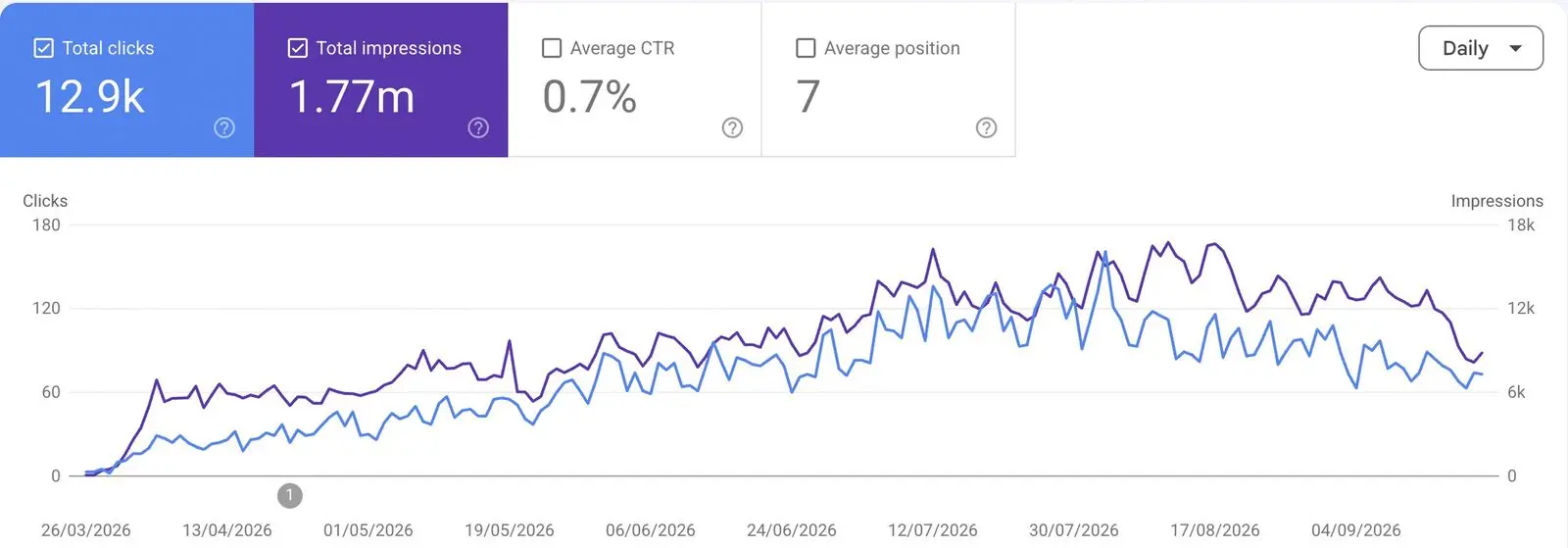 Search Console for the same site, from launch to September 2026. It counts clicks from Google, not Analytics sessions, and it shows the first three weeks were the start of the climb, not a launch spike.
I write this post because the hotel website design market is full of inflated quotes, padded retainers, and template work sold as "custom." Hoteliers deserve to know what they are paying for.
Hotel Website Cost: The Five Pricing Tiers, Explained
Tier 1: DIY Templates (Wix, Squarespace, Hostinger Builder)
Price: 200 to 800 EUR upfront, 15 to 40 EUR/month ongoing.
These platforms have come a long way. You can launch a passable hotel website in a weekend. The drag-and-drop editor is forgiving. There is a free SSL certificate and a half-decent mobile view by default.
What you sacrifice:
- Page speed is mediocre. Most templates load 3 to 6 MB of JavaScript and CSS you do not need.
- SEO is basic. You can fill meta titles and descriptions, but you will not get proper schema, you will not control sitemap structure, and you will fight the platform on technical SEO.
- Booking engine integration is limited. You can embed Hotelbeds, Reserve-Online, SiteMinder, or others as iframes, but the experience is clunky and rarely converts well.
- You are renting your site. The day you leave Wix, the design does not come with you.
Who it suits: A 4 or 5 room guesthouse, a seasonal villa, or a property where the website is a brochure and 80% of bookings come from Booking.com anyway.
Tier 2: WordPress with a Hotel Theme
Price: 1,500 to 4,000 EUR.
You buy a hotel theme on ThemeForest (Hotel Master, Hotel Booking, or one of a dozen others), find a freelancer who configures it, plug in a booking engine, and you have a real hotel website.
This is what most small hotels in Greece are running today. Done well, it works. The problem is most of them are not done well.
What goes wrong:
- The theme has 80 features you do not need. They sit in your codebase and slow down every page.
- Updates break things. WordPress, the theme, and three plugins all update on different schedules.
- Speed is hit or miss. A typical hotel theme scores 30 to 50 on mobile PageSpeed without serious optimization.
Who it suits: Properties that want more control than Wix offers, accept some technical management, and have someone they trust to keep it healthy.
Tier 3: Custom WordPress Build
Price: 2,000 to 9,000 EUR.
Here you stop using a generic theme. A hotel website developer builds a custom theme tailored to your property. You get a clean codebase, only the features you need, proper schema markup for hotels and rooms, a custom hotel booking engine integration, and a multilingual setup that is not an afterthought.
This is the sweet spot for boutique hotels with 8 to 30 rooms. You get a custom hotel website that looks distinctive, loads fast, and ranks. You can manage rooms, offers, and content yourself. The codebase belongs to you.
What you should expect to be included:
- A design system that fits your brand, not a stretched stock template
- Booking engine integration that converts (single page, no jarring redirect)
- Schema markup for Hotel, LodgingBusiness, and Room
- Multilingual setup with proper hreflang tags
- Sitemap and robots.txt that let search engines and AI crawlers in
- PageSpeed mobile scores above 85
- Trained handover so your team can update content
Tier 4: Custom Next.js or Headless Build
Price: 8,000 to 25,000 EUR.
This is what I built for Aroma Suites and Uma Ray Suites. The frontend is React (Next.js), deployed on Vercel or similar edge infrastructure. The content can sit in a headless CMS or in WordPress as a backend. If you're still choosing between the two platforms, I compare them on two real sites in Next.js vs WordPress.
Why it costs more:
- Actual engineering, not configuration. A Next.js project is a real codebase. Component architecture, server-side rendering, image optimization, and edge caching all need to be designed.
- AI search readiness. Sites like this can hit Core Web Vitals scores of 95+ on mobile, which Google's CrUX field data uses for rankings.
- Custom integrations beyond the booking engine. PMS sync, channel manager hooks, custom analytics, AI chatbots.
What this gets you:
- Page speed that beats almost every competitor on the SERP
- A site that ranks on technical SEO without you fighting the platform
- A foundation that lasts 4 to 6 years before needing a real rebuild
Who it suits: Properties with 10+ rooms where direct bookings drive serious revenue. Hotels in competitive destinations (Santorini, Mykonos, Crete, Amalfi, Algarve). Multi-property owners.
Tier 5: Enterprise Multi-Property
Price: 25,000 EUR and up. Often 40,000 to 120,000 EUR for hotel groups.
Multi-language, multi-currency, multi-property. Deep PMS integration. Real-time inventory. Loyalty programs. AB testing infrastructure. A small team to maintain it.
If you are a hotel group, you already know this is your bracket. If you are not, do not let an agency sell you into it.
What Actually Drives the Price
Stop thinking about pages. Start thinking about complexity. Here is what changes the cost more than anything else:
Booking engine integration depth. An iframe takes a day. A custom-styled, single-page integration with availability calendars, room comparison, and add-on packages takes a week or more.
Multilingual. One language is one site. Three languages is roughly 1.6x the work, not 3x, but content review and translation coordination eat real hours. How I handle hreflang, the language switch and translation is in my multilingual website guide.
Number of room types. Five room types means five room pages, five sets of photography, five sets of structured data. Twenty room types is a different project.
SEO depth. "Set the meta tags" is one thing. Building a site that actually ranks requires keyword research, content planning, schema markup, internal linking strategy, and technical hygiene. This is the work most agencies skip and call it SEO anyway.
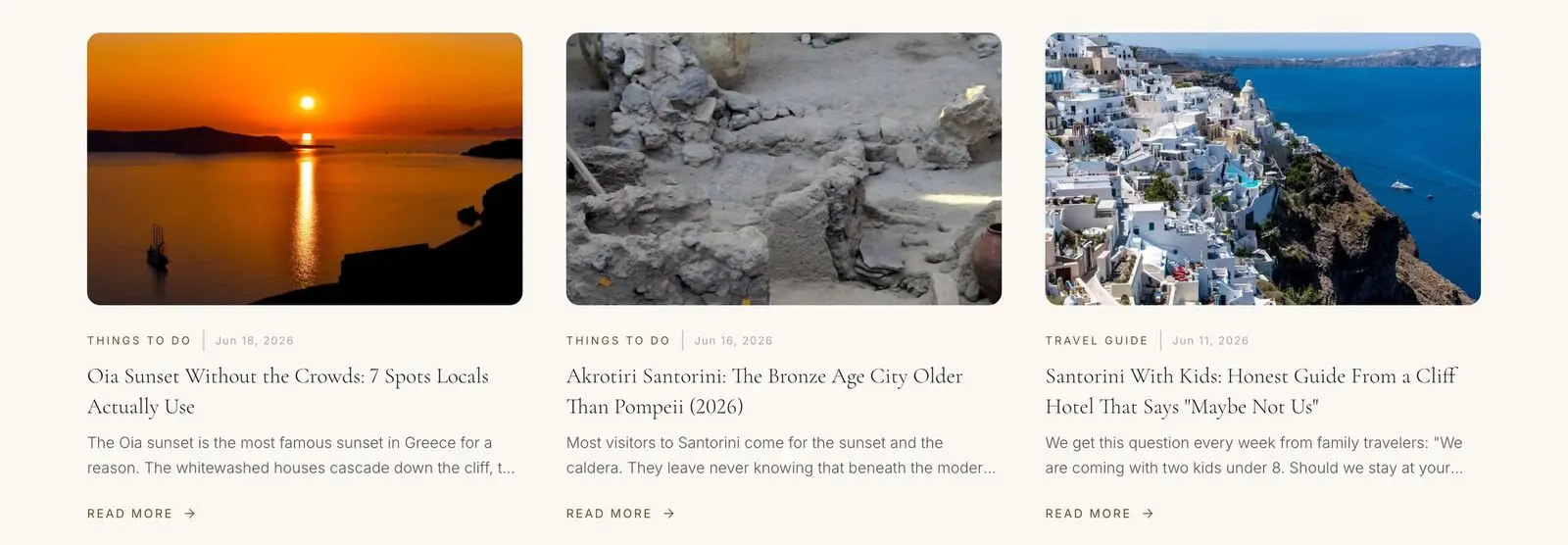 What content planning looks like on a live hotel site: guides that answer what guests search before they pick a hotel. "Set the meta tags" never produces this.
Design system maturity. A "we will use this Figma kit" project costs less than a "we want a custom visual identity that matches our property" project.
AI chatbot or concierge. A modern hotel chatbot that actually answers guest questions costs 1,500 to 6,000 EUR on top of the build. Most properties do not need one in year one. I wrote a full breakdown of how hotel chatbots work and where they break in my AI chatbots for hotels guide. For where else AI fits in a hotel and what to set up first, see my guide to AI for hotels.
OTA channel manager hooks. If you want availability and rates pulled from your channel manager into the site in real time, that is custom integration work. Add 1,500 to 4,000 EUR. Some properties skip this and use a set of automated workflows instead, which I cover in 30 n8n automation ideas for service businesses.
A Real Example: Aroma Suites
We rebuilt the Aroma Suites site in early 2026. Here is what the project actually looked like. The full write-up, with dated Search Console figures, is in the Aroma Suites case study.
- Stack: Next.js, headless CMS, Vercel deployment, Reserve-Online booking engine
- Pages: home, 6 room types and a villa, dining, location, gallery, contact, blog, 4 legal pages
- Languages: English and Greek
- Timeline: 6 weeks from kickoff to launch
- Result: 90 organic sessions in launch week and 537 in the first three weeks (Google Analytics, 28 March to 18 April 2026), no paid traffic, PageSpeed scores 97/100/100/100 on mobile
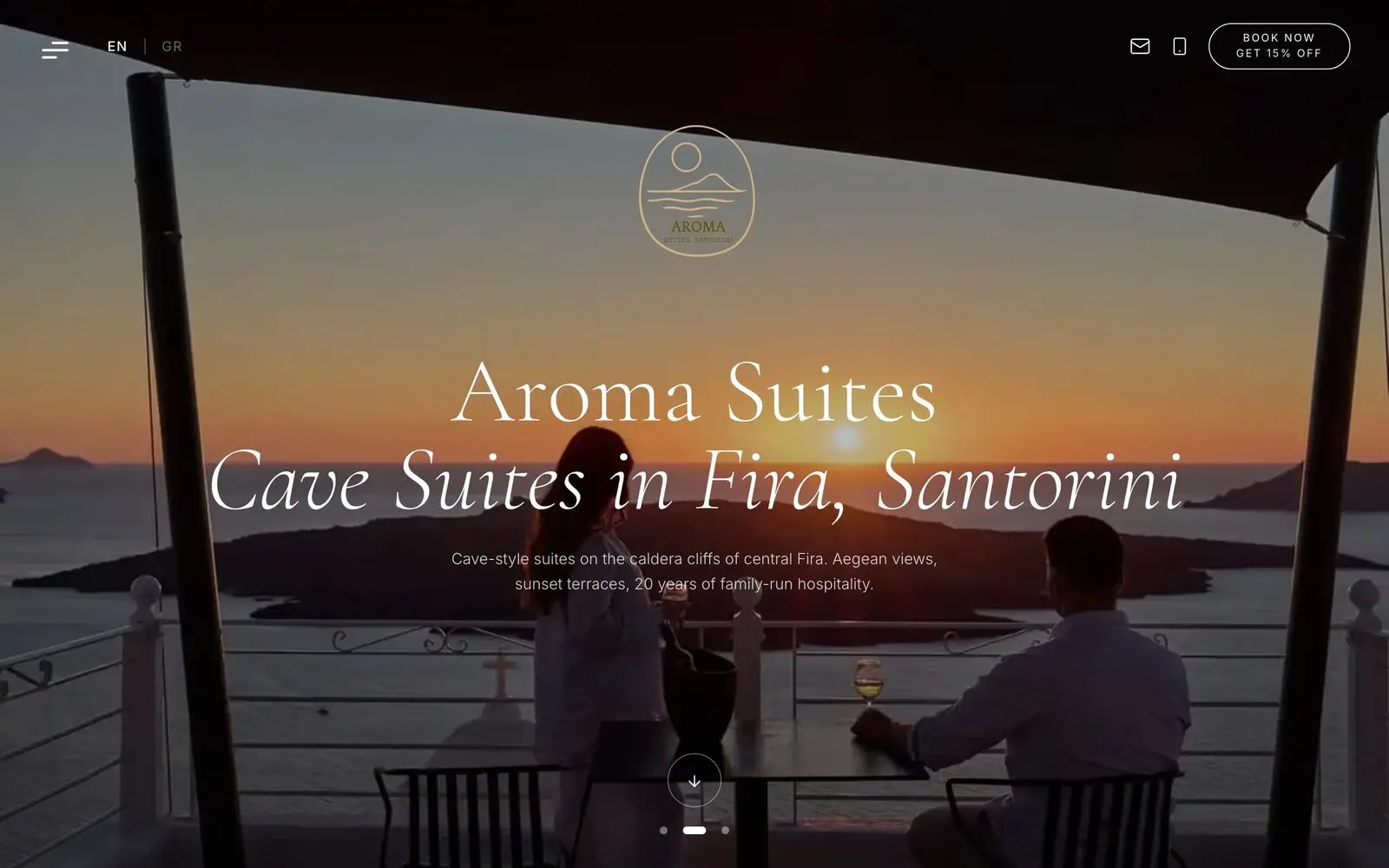 The Aroma Suites site as it ran on 23 September 2026. The Book Now button and the EN/GR switch sit in the header, which is where the booking engine integration and the two languages on the list above end up.
The total budget sat in the upper end of the Tier 4 range. What made it work was not the price tag. It was the fact that SEO was built in from day one, not bolted on after launch. Schema markup, semantic HTML, proper internal linking, and image optimization all happened during development, not as an "SEO package" sold separately three months later. Whether AI search then cites you is a separate question, and I measure it on my own site in how to rank in ChatGPT.
Common Mistakes Hoteliers Make When Buying a Website
1. Buying on price alone. A 1,200 EUR website that loses 5 direct bookings per month is more expensive than an 8,000 EUR website that gains 5. Run the math.
2. Buying on aesthetics alone. A beautiful site that loads in 8 seconds and is not indexed properly will not rank, will not convert, and will not pay for itself.
3. Letting the agency choose the booking engine. Some agencies have referral deals with booking platforms. Pick the booking engine that fits your property and your PMS. Then ask the developer to integrate it.
4. Paying for "SEO" as an add-on. SEO done after the build is fixing what should have been built right. Insist that technical SEO is part of the base scope, not a separate package. What that work covers for a hotel, from schema to the map pack, is on my hotel SEO page.
5. Skipping the rebuild question. If your old site has indexed URLs, your new site needs to either preserve those URLs or redirect them properly. A redesign that 404s every old page erases years of search visibility. This is non-negotiable. Here's how I relaunch a site without losing rankings.
6. Treating the website as a one-time project. A website is a system. It needs updates, performance monitoring, content additions, and SEO maintenance. Budget for hosting plus maintenance: my maintenance plans start at 100 EUR a month, with hosting billed separately (prices before 24% VAT).
What You Actually Need vs What Agencies Will Try to Sell You
You need:
- Fast load times on mobile (under 2.5 seconds LCP)
- Clear room pages with real photos, prices, and a working booking flow
- Schema markup so your hotel and rooms appear in rich results
- Multilingual setup if your guests come from more than one country
- A clean URL structure with descriptive slugs (
/rooms/jacuzzi-cave-suite, not/r/jcs) - Sitemap and robots.txt
- A way to update content without paying for every change
You probably do not need (in year one):
- A custom-built PMS, even though one will be pitched
- Live chat staffed 24/7
- Personalization based on visitor cookies
- A bespoke AI concierge
- A blog before you have a content plan
- Three CTAs on every section "for conversion"
Recommendations by Hotel Size
Boutique (5 to 15 rooms): Tier 3 custom WordPress build. Spend 2,000 to 7,500 EUR. Get clean code, proper SEO, and a booking engine that converts. Plan for maintenance from 100 EUR/month (before 24% VAT).
Small to mid (15 to 50 rooms): Tier 4 custom Next.js or strong custom WordPress. Spend 8,000 to 16,000 EUR. The traffic and direct booking volume justify the engineering. Plan for maintenance from 100 EUR/month and, if you want ongoing SEO, from 250 EUR/month (both before 24% VAT).
Large (50+ rooms or multi-property): Tier 4 high end or Tier 5. Bring in a developer who has built for hotel groups. Spend the time scoping properly. The integration work alone can run 6 to 8 weeks.
How to Vet a Hotel Website Developer
Ask these questions before you sign anything:
- Can you show me three hotel sites you built and their current PageSpeed scores?
- What schema markup will you implement for hotel and rooms?
- How will you handle URL preservation if I have an existing site with indexed pages?
- Will the codebase belong to me, and can I move it if I leave?
- What is included in technical SEO at launch, and what is sold separately?
If the answers are vague, walk away. The technical questions are not optional. They are the difference between a site that ranks and a site that just exists.
FAQ
How much does a small hotel website cost?
For a 5 to 15 room boutique hotel, expect 2,000 to 7,500 EUR for a properly built custom WordPress site with booking engine integration, schema markup, and multilingual setup. Templated builds run 1,500 to 4,000 EUR but trade off speed and SEO control.
Is WordPress or Next.js better for a hotel website?
WordPress is faster to build, easier to update, and fine for most properties under 30 rooms. Next.js delivers better Core Web Vitals scores, faster page loads, and a stronger AI search foundation, but costs more and needs a developer for content structure changes. If direct bookings drive serious revenue, the Next.js investment pays back.
How long does it take to build a hotel website?
A templated WordPress site takes 2 to 4 weeks. A custom hotel website on WordPress runs 4 to 8 weeks. A custom Next.js build runs 6 to 12 weeks. Add 2 to 4 weeks for content, photography, and translations.
How much does a hotel website design cost on average?
For a small boutique hotel in 2026, expect 2,000 to 8,000 EUR for a properly executed custom hotel website design that includes a booking engine integration, schema markup, and multilingual setup. Templated builds run 1,500 to 4,000 EUR, and bespoke Next.js builds run 8,000 to 25,000 EUR. The price tracks complexity, not pages.
What ongoing costs should I budget for?
Hosting runs 15 to 80 EUR/month depending on the platform: 30 to 80 EUR/month on a WordPress site and 0 to 50 EUR/month on Next.js (Vercel free tier covers most boutique properties). Maintenance on top starts at 100 EUR/month with me, and ongoing SEO at 250 EUR/month, both before 24% VAT.
Do I need a hotel booking engine, or can I use Booking.com only?
You should have both. OTAs bring volume but take 15 to 22% commission. A direct booking through your own site costs you 0 to 3% in payment processing. Even at 30% direct bookings, the math pays back the website inside 12 months for most properties.
What is "AI search readiness" and do I need it?
AI search readiness means your site can be parsed and cited by ChatGPT, Perplexity, Gemini, and Google's AI Overviews. It involves clean semantic HTML, proper schema markup, and content structured for citation. In 2026 it is no longer optional. AI traffic is a real and growing share of how guests find hotels.
Want to Talk About Your Project?
I build hotel websites for properties in Greece and beyond. If you are weighing a redesign, planning a new build, or trying to figure out what tier you actually need, you can see my work on my portfolio or reach out directly.
I will give you a straight answer about what your project should cost and what should be in scope. No padded retainers, no agency markup, no upselling you into a bracket you do not need.