Aroma Suites Case Study: A Santorini Hotel Website Redesign on Next.js
Hotel website redesign case study: how I rebuilt Aroma Suites in Santorini in March 2026, and what Search Console and GA4 have recorded since.

Short answer
In its first three weeks, 28 March to 18 April 2026, the rebuilt Aroma Suites site recorded 537 organic search sessions in GA4, and in August 2026 Google Search Console counted 3,171 clicks. This case study shows how I moved the Santorini cave hotel from WordPress to Next.js in March 2026, with a date and a source for every number.
This is a hotel website redesign case study where every number has a date and a source. In March 2026 I rebuilt the website of Aroma Suites, a cave hotel in Fira, Santorini, and moved it off WordPress onto Next.js. The traffic figures below come from Google Search Console and Google Analytics 4, and I pulled them on 23 September 2026. If I couldn't back a number up, it isn't here.
At a glance
| Client | Aroma Suites |
| Sector | Hospitality, boutique cave hotel |
| Location | Fira, Santorini, Greece |
| Year | 2026 (audit 17 March, new site live 28 March) |
| Services | Site audit, design and build, technical SEO, travel content, AI chat assistant, analytics and booking attribution |
| Stack | Next.js 15, React 19, Tailwind CSS v4, Vercel, WebHotelier booking engine, GA4, Google Search Console |
| Live site | aromasuites.com |
The starting point, March 2026
On 17 March 2026 I audited the old site, a WordPress and Elementor build. It scored 52/100 on my manual review and 59/100 on the automated report I run alongside it. Both are my own audit scores, not a Google metric.
The problems were concrete:
- Booking links returned 403 errors, so some guests who clicked "book" hit a wall.
- There was no Hotel schema, so search engines had no structured facts about the property.
- 78% of images had no alt text.
- The main content ran to 348 words.
- The crawl found 57 orphan pages that nothing linked to.
The hotel also had no Search Console property and no analytics history. That matters for everything below: I have no "before" traffic figure, so this case study doesn't claim a percentage increase. It shows what the new site has done since launch.
What the hotel website redesign included
A custom Next.js site, live on 28 March 2026
Eleven days after the audit, the domain pointed to the new build on Vercel. The design runs on a gold, cream and charcoal palette with a serif and sans pairing, and a custom admin panel lets the hotel edit rooms and content without touching code.
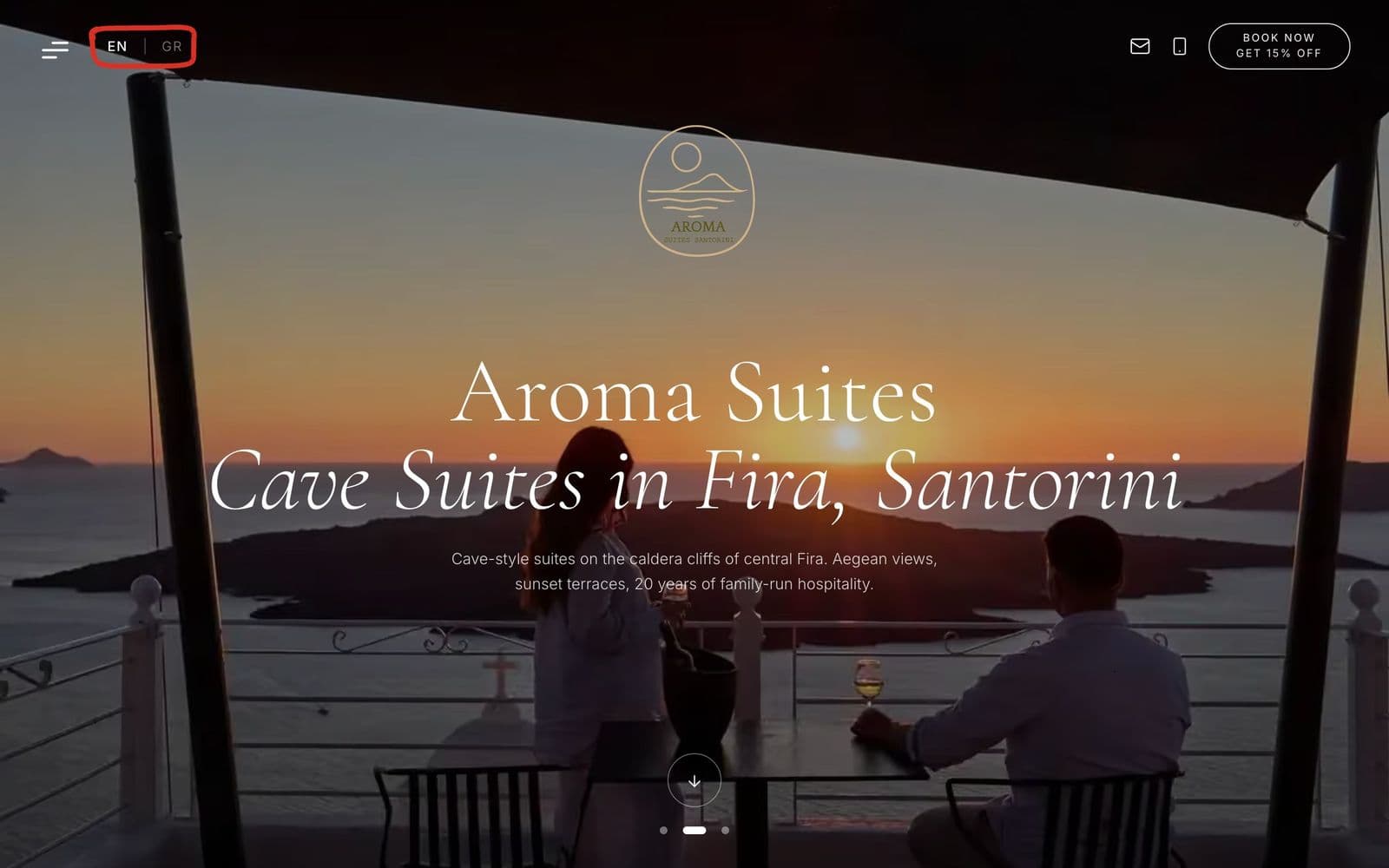 The new site as it runs today, 23 September 2026. The circled language switch is one click and remembers your choice across pages. The booking button sits at the top of every page.
Structured data the old site lacked
The homepage carries Hotel schema and every room page carries its own HotelRoom schema with an offer. I checked both on the live site on 23 September 2026.
English and Greek, where it helps
The core pages run in English and Greek with a language toggle that sticks across pages. The travel guides stay English only, because the people reading them are international guests planning a trip, not Greek speakers.
Travel content aimed at what guests search
The site launched with 28 guides in its Discover section, on the questions people ask before a Santorini trip: airport transfers, the cable car, weather, restaurants in Fira, cave hotels. My AI content pipeline pulled keyword data from DataForSEO and wrote the drafts, then ran SEO and editing passes on each one. On 23 September 2026 the Discover index links to 67 guides.
Speed work on the article template
Moving markdown rendering from the browser to the server cut the blog bundle from 509 KB to 152 KB and took Total Blocking Time on the slowest posts from 930 ms to 20 ms. The mobile PageSpeed lab scores recorded on 28 March 2026 were 91 to 96 on the main pages and 80 to 93 on articles, with SEO at 100 everywhere.
An AI chat assistant, added 7 April 2026
It answers guest questions from the site's own content and runs on Liberators OS, the agent platform I built. I wrote about how these bots work in hotels in my guide to AI chatbots for hotels.
Open to AI crawlers
The robots.txt allows search and AI crawlers explicitly and carries a Content-Signal line that permits search, AI answers and training.
Booking attribution, fixed 17 to 21 April 2026
Bookings happen on the WebHotelier engine, a separate domain. I added GA4 cross-domain linking and UTM tags on all 20 booking links so a purchase can be traced to the page and button that sent the guest.
Results, with dates and sources
Search Console counts clicks from Google results. The figures are for the domain property sc-domain:aromasuites.com.
| Period | Clicks | Impressions | Source |
|---|---|---|---|
| Launch week, 28 March to 3 April 2026 | 80 | 14,253 | Google Search Console |
| First 30 days, 28 March to 26 April 2026 | 720 | 147,161 | Google Search Console |
| August 2026 | 3,171 | 440,861 | Google Search Console |
| 22 June to 19 September 2026 | 8,833 | 1,159,959 | Google Search Console, average position 6.9 |
| 1 February to 30 September 2026 (data starts 26 March) | 13,603 | 1,845,623 | Google Search Console, average position 7.0 |
In other words, from 0 to about 13,600 clicks from Google in six months. The 0 is where measurement started (Search Console was set up on 26 March, two days before launch), not a reading of the old site.
GA4 roughly agrees. In launch week it recorded 90 organic search sessions from 58 users. GA4 counts sessions that loaded a page and passed the cookie banner, so it will never match Search Console exactly.
August is peak season in Santorini, so the jump from spring to summer is part growth and part calendar. I don't have a full year yet to separate the two.
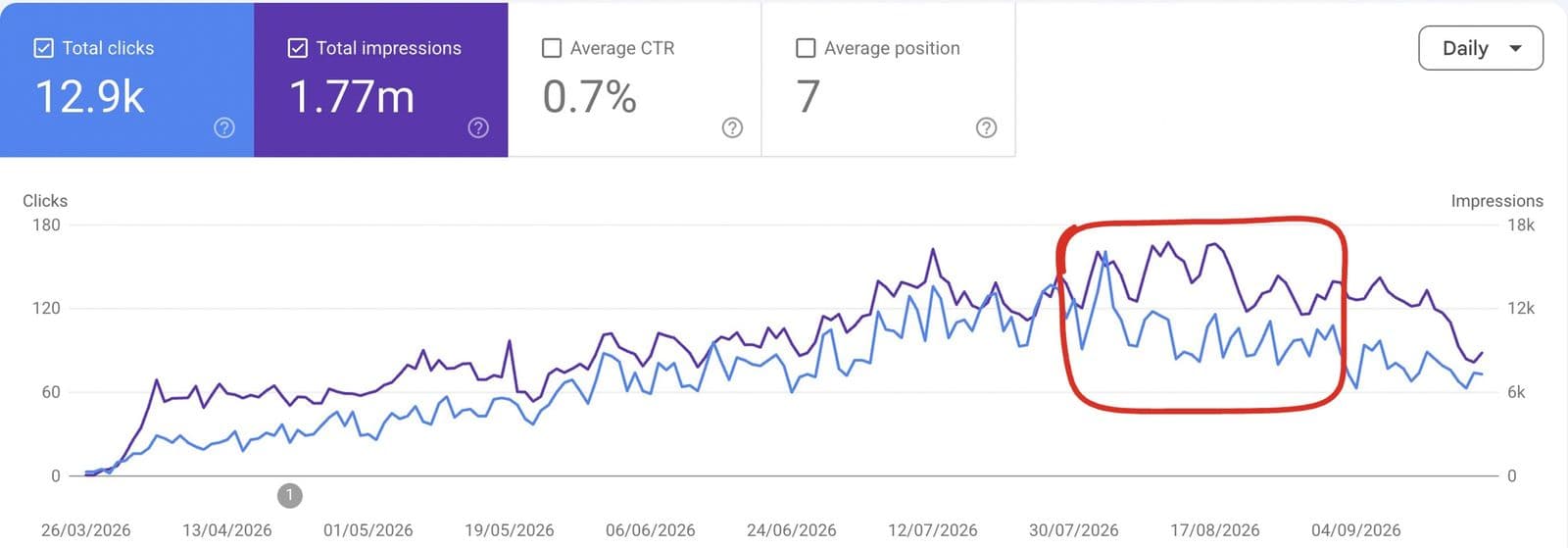 Clicks and impressions from launch day to September, day by day. The circled stretch is August, the peak month in the table. The table gives four snapshots, the chart shows the path between them.
Most of the traffic lands on travel guides, not on the homepage. Over 22 June to 19 September 2026 the top page was the cable car guide, with 938 clicks, followed by the Fira restaurants guide with 665. The homepage took 627, and 471 of the 478 homepage clicks Search Console ties to a query came from people searching the hotel's name.
Bookings
On 17 April 2026 the owner confirmed in WebHotelier that the new site had produced zero direct bookings so far. Three weeks of rising traffic, and no bookings. GA4 recorded the first purchase on 18 April 2026, and 40 purchase events between then and 22 September 2026. GA4 doesn't subtract cancellations, so WebHotelier stays the real ledger. That's why I quote the count and not revenue.
What I'd do differently
Check whether a keyword can be won before writing for it
The weather guide is the clearest example. From 22 June to 19 September 2026 it collected 160,455 impressions and 368 clicks, a click-through rate of 0.23% at an average position of 7.6. The page ranks, but on 23 September 2026 three of the top five US results for "santorini weather" were timeanddate.com, weather.com and the BBC. My read is that searchers click those instead. I now run a winnability check on every keyword before an article gets written.
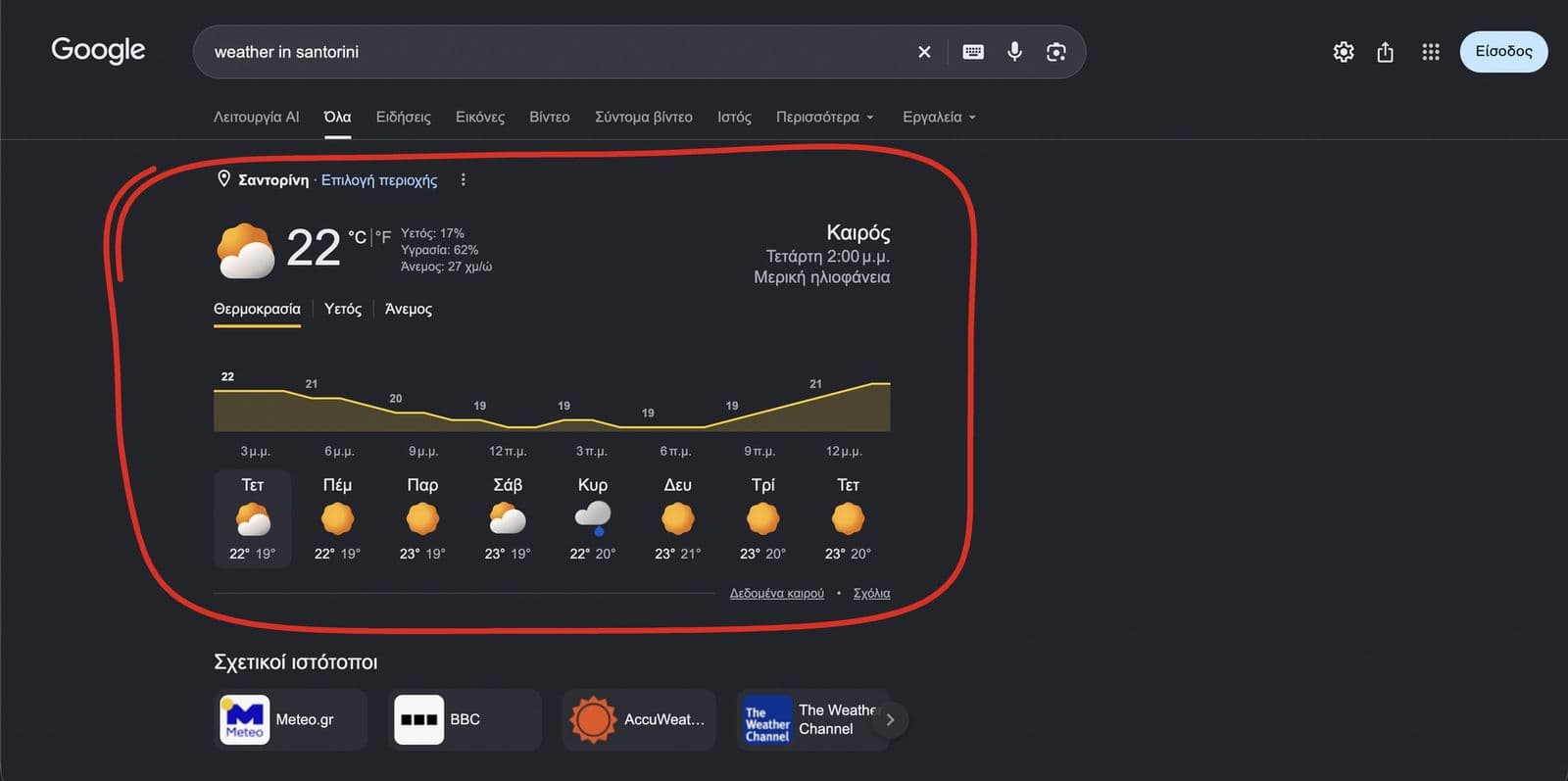 What a searcher sees for weather in santorini. The circled widget answers the question before any result, which is why a guide at position 7 gets almost no clicks.
Wire booking attribution before launch, not after
For the first three weeks I could see traffic but not which pages led to a booking. The cross-domain and UTM work belonged in the launch checklist.
Measure the old site before replacing it
Had Search Console and GA4 run on the WordPress site for a few weeks, I could tell you how much better the new site does. All I can tell you is what it does.
FAQ
How long did the Aroma Suites rebuild take?
Eleven days from audit to launch: the audit ran on 17 March 2026 and the new site went live on 28 March 2026. Content, the chat assistant and tracking fixes kept shipping through April.
Where do guests book?
On the hotel's WebHotelier booking engine. The website sends guests there with tagged links, so GA4 can usually tie a booking to the page that started it.
Does the travel content lead to bookings?
I can trace it per booking now, but I don't have a total yet. Of the three bookings I traced in late May 2026, two started on the site itself (the Jacuzzi Cave Suite page and the header "Book Now" button) and one came through Google's free hotel booking links.
Summary
Aroma Suites, a cave hotel in Fira, Santorini: a hotel website redesign from WordPress to Next.js by Panagiotis Karampetsos, live on 28 March 2026. Google Search Console recorded 80 clicks in launch week and 3,171 clicks in August 2026.
If your hotel site looks fine but brings in nobody, tell me about it. You can see my other builds on the portfolio page, including a car rental SEO case study from Chania and a Pilates platform with subscriptions and an iOS/Android app. If you want the same search work on your own property, here is how I run hotel SEO. For how Google counts these numbers, see the Search Console performance report documentation and the schema.org Hotel type.