Website Maintenance Cost: What a Small Business Actually Needs
Website maintenance cost for a small business: what hosts, agencies and Greek price lists charge, what a monthly plan covers, and my own prices with VAT.

Short answer
How much does website maintenance cost? For a small business, usually somewhere between a few tens and a few hundred euros or dollars a month. According to Bluehost's maintenance cost guide, freelancers charge $50 to $150 a month for essential maintenance and agencies $200 to $1,000+ a month for fuller service. In Greece, Cactus Web's 2026 cost guide puts maintenance and support at €50 to €300 a month.
My own prices are public: €100 a month for basic maintenance with two to three hours of small changes, €200 for up to 6 hours with monitoring, and €350 for up to 10 hours with a monthly speed and SEO check. All three are plus 24% Greek VAT. Below is what the market charges, what a maintenance plan should actually cover, and how WordPress and Next.js sites differ in what they need.
Website maintenance cost: what hosts, agencies and Greek price lists charge
Nobody sets an official price for website maintenance, so the honest answer comes from the people who sell it. These are the sources I opened on 7 October 2026. The numbers are theirs.
| Source | What it reports | Market |
|---|---|---|
| Data: Bluehost (updated 9 February 2026) | Freelancers $50 to $150 a month; agencies $200 to $1,000+ a month; on-demand support $75 to $200 an hour | US host's view, in USD |
| Data: Liquid Web (updated 12 August 2025) | Example plans for agencies: $150 a month for a small business, $900 a month for an enterprise plan | US host, advice to agencies, in USD |
| Data: Cactus Web (10 April 2026) | Maintenance and support €50 to €300 a month | Greece, in EUR |
| Data: istosite.gr | WordPress care plans at €40, €65 and €95 a month, plus VAT | Greece, in EUR |
| Data: Grecode | Maintenance from €150 a year | Greece, in EUR |
Read these with two caveats. Bluehost and Liquid Web sell hosting and maintenance, so their figures describe their own market. And the Greek range is wide because the plans aren't the same product: some are mostly automated updates and backups, others include a person making changes to your site.
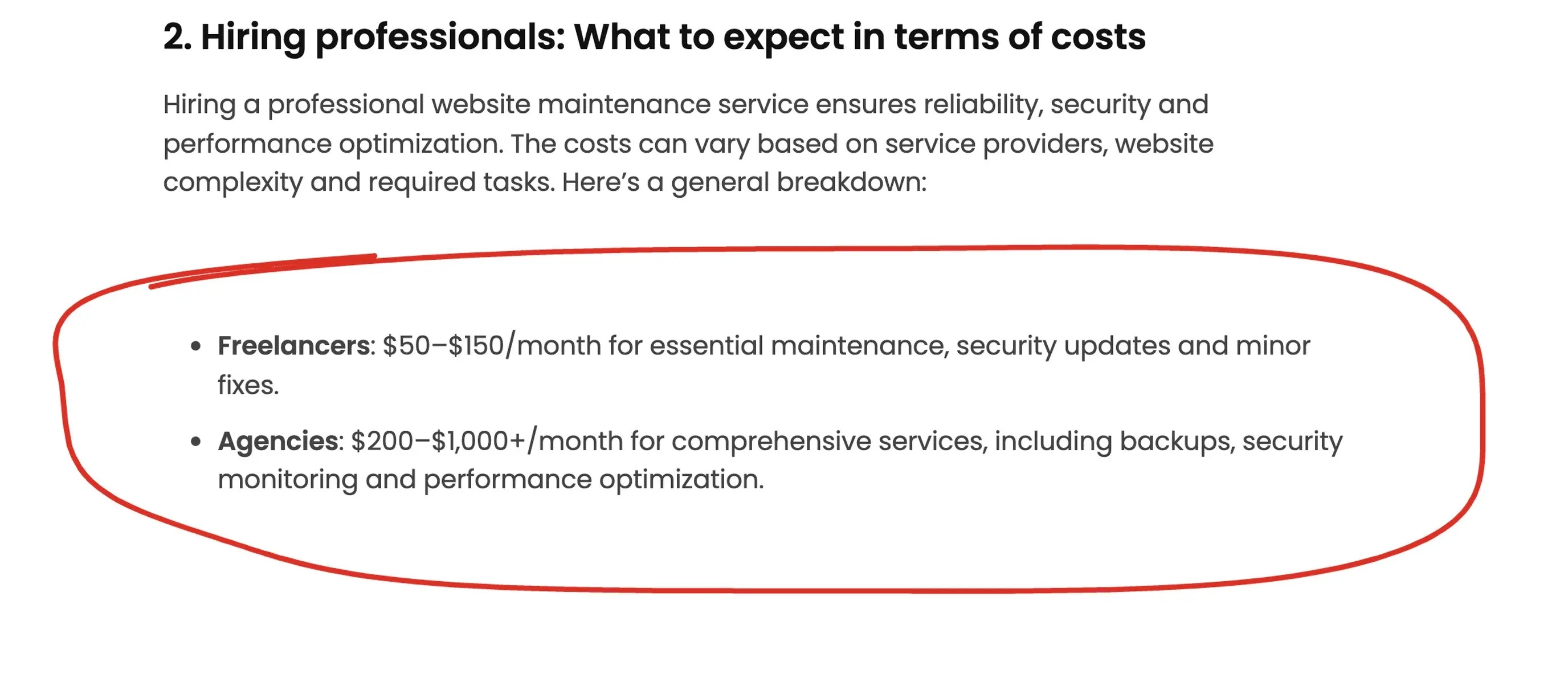 The freelancer and agency rates in Bluehost's guide, as I opened it on 7 October 2026. The gap between the two lines is mostly about who does the work and how much of it is a human, not about the software.
What's actually in a website maintenance package
That last point is the one to check before you compare prices. Look at what the hours buy, then at the monthly figure.
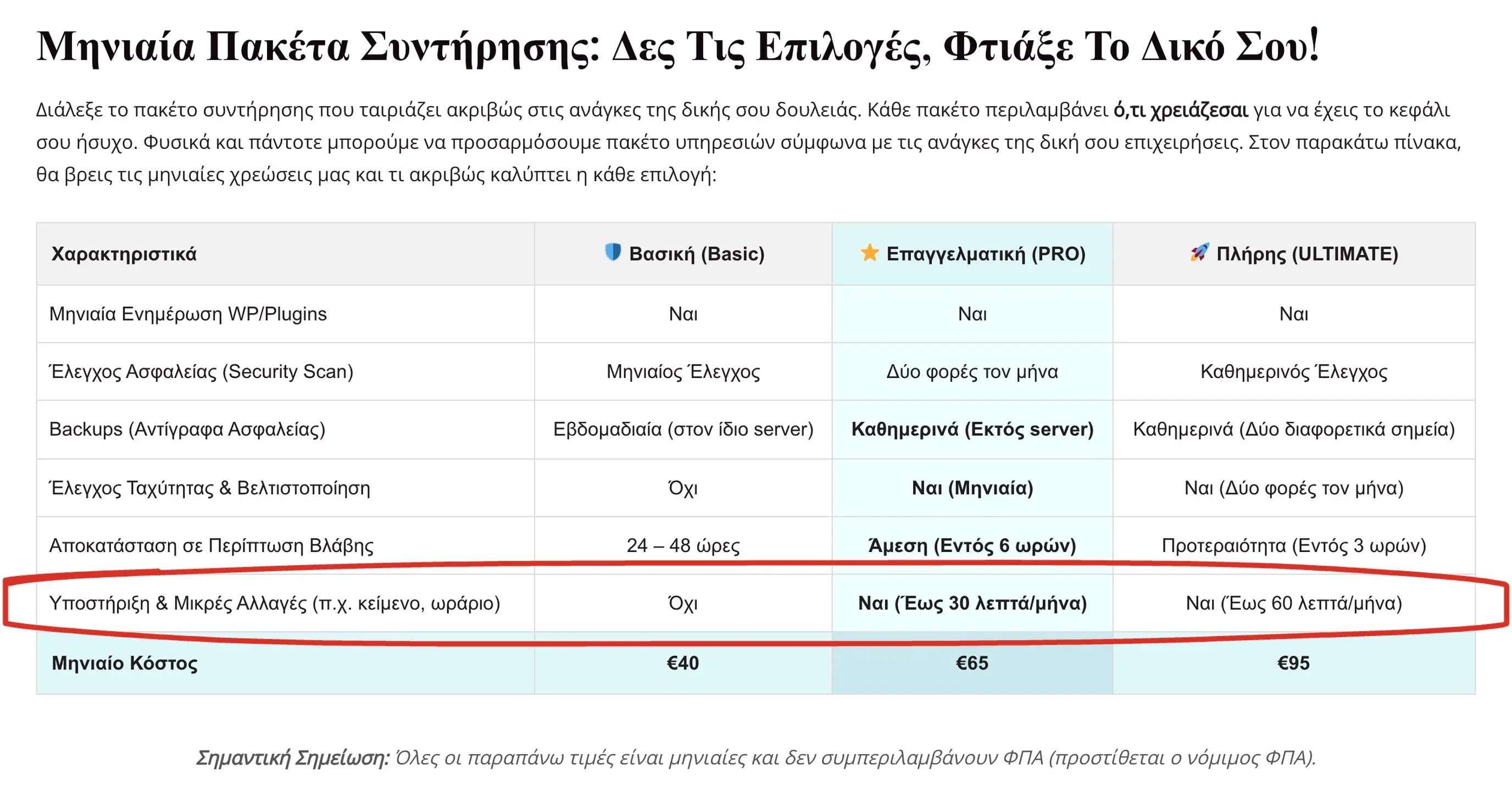 A public Greek price list from istosite.gr, opened on 7 October 2026. The circled row is the one most owners skip: how much human time for changes the plan includes. Here it's none, 30 minutes or 60 minutes a month.
A plan like that is a fair deal for what it is: updates, scans and backups for a site nobody needs to touch. It isn't the same thing as someone who changes your opening hours, fixes the contact form after a plugin update and adds a new page for a seasonal offer. Most small businesses I work with need the second kind.
There's also the billing model. A monthly plan buys a fixed amount of work every month. Paying by the hour suits a site that almost never changes: Bluehost's figure for on-demand support is $75 to $200 an hour in the US. For a site that takes bookings or payments, I'd rather have someone already on it than pay by the hour to find out what broke.
So a useful website maintenance package covers these parts:
- Updates. The CMS, theme, plugins and libraries, applied with a backup taken first and the site checked after.
- Backups. Kept somewhere other than the same server, and tested by restoring one now and then.
- Security and uptime monitoring. Something that notices when the site is down or changed, before a customer does.
- Small changes. Text, prices, photos, opening hours, a new section on a page.
- Health checks. Speed, broken links and the pages Google stopped indexing.
The other running costs: hosting, domain and SSL
Maintenance is the work. The site also has running costs that most quotes list separately, and you should know them before you compare two offers.
According to Cactus Web's cost guide, a domain costs €10 to €30 a year in Greece and hosting €50 to €500+ a year depending on the site, while an SSL certificate is usually free through Let's Encrypt. Bluehost's US figures are in the same range: $10 to $50 a year for a domain and $5 to $30 a month for hosting.
When a maintenance quote looks cheap, check whether hosting is inside it or billed on top. When it looks expensive, check whether it includes hosting you're already paying for elsewhere.
Why WordPress sites need monthly maintenance
On WordPress, plugins are where most of the maintenance work goes, because that's where most of the risk sits. Keep that in mind when you compare WordPress maintenance cost between offers. According to Patchstack's 2026 WordPress security report, 11,334 new vulnerabilities were found in the WordPress ecosystem in 2025, and 91% of them were in plugins.
WordPress applies minor and security updates to its own core in the background, but you still have to update plugins and major releases yourself, as the WordPress documentation on updating explains. The same page says it's a good idea to back up your website before you start. That's the routine: backup, update, check the pages that make you money, and roll back if something broke.
On WordPress sites I look after, maintenance hours also go to fixes nobody asked for out loud. On Kokos Rental, a car rental in Chania running on WordPress, a July 2026 session took the homepage fleet carousel from 762 KB of images to 402 KB. I took a database backup before touching anything. If your WordPress site has got slower over time, the causes and fixes are in WordPress speed optimization.
Does a Next.js site need maintenance too?
Yes, less often, but it does. A Next.js site has no plugin directory to keep up with, which removes most of the monthly update work. It still runs on a framework and the libraries it pulls in, and those get security fixes.
According to the Next.js security advisory for CVE-2025-29927, published 21 March 2025, it was possible to bypass authorization checks done in middleware. The advisory rates it critical, CVSS 9.1, and the fix was to upgrade, for example to 15.2.3. The same advisory says sites hosted on Vercel were protected automatically. Sites hosted elsewhere needed someone to upgrade them.
The other kind of Next.js maintenance is cost and behaviour on the host. In July 2026 the Aroma Suites site, which I built on Next.js, used more server CPU time in a month than its hosting plan allowed. One line in the layout made the main pages render on every request, and bot traffic did the rest. I fixed it in code and the pages went back to being served as static files. That's a maintenance job, and no plugin would have caught it. I compare the two platforms in more detail in Next.js vs WordPress.
My website maintenance prices
I publish my prices so you can compare them with the lists above. Each plan is a monthly fee, quoted without VAT, for WordPress and Next.js sites alike.
| Plan | Per month, without VAT | Per month, with 24% VAT | Hours of work included |
|---|---|---|---|
| Basic | €100 | €124 | 2 to 3 hours |
| Standard | €200 | €248 | Up to 6 hours |
| Extended | €350 | €434 | Up to 10 hours |
I calculated the with-VAT column at 24%. If you're a business with a Greek VAT number you offset it, so the net price is the one that matters to you. If you're a private person, you pay the with-VAT price.
Basic: €100 a month
For a small site that mostly stays the same. Each month I apply the updates, check that the backups are running, and spend two to three hours on small changes you send me: a new price, new photos, a changed phone number, a fix on a page that looks wrong on mobile.
Standard: €200 a month
Everything in Basic, with up to six hours, plus uptime and security monitoring, so I hear about a problem from a monitor rather than from you. It suits a business whose site takes bookings or enquiries every day, where a broken form costs real customers. The small content changes fit inside the hours.
Extended: €350 a month
Up to ten hours, with your requests going ahead of the queue. Every month I also run a speed and SEO health check: page speed, broken links, indexing problems in Search Console, and the fixes that come out of it. The hours are enough for small new sections, like a new service block or an FAQ on a page. It's the plan for an e-shop or a booking site that keeps changing. If you're still choosing a platform for a shop, start with WooCommerce vs Shopify.
What none of the plans include
A new website or a full redesign is a separate project with its own price. What a site costs in Greece is in web design in Greece, and when a redesign makes sense is in website redesign cost. Ongoing SEO work, like content and local listings, is a separate plan too, priced in how much does SEO cost. The health check in Extended finds technical problems. It doesn't replace an SEO plan.
Hosting is billed separately from the maintenance plans: €200 to €500 a year depending on the plan, with the top plan also covering media (images and video) storage. Unused hours don't carry over to the next month. Work beyond a plan's hours is €50 an hour if you're on a plan and €80 an hour if you're not, both before VAT.
Which plan does your site need?
Pick by how often the site changes and how much money passes through it, not by its size.
A small brochure site for a plumber or a lawyer that changes twice a year needs Basic, and some months it won't use all the hours. A hotel or rental site that takes direct bookings needs Standard, because a day with a broken booking form can cost more than a month of the plan. An e-shop with weekly product and price changes needs Extended.
If your current provider charges you a monthly fee, ask them two questions: how many hours of human work it includes, and when they last restored a backup to test it. If the answers are "none" and "never", you're paying for automated updates. That can be fine, as long as you know it.
Can you maintain a website yourself?
Yes, if it's a simple site and you're careful. On WordPress, take a full backup, update one plugin at a time, and check the contact form and the pages that bring you customers after each one. The technical SEO checklist has the checks I run after any change that could affect search.
Where owners get into trouble is the update that breaks something late at night before a busy weekend, with no backup to go back to. If the site takes payments or bookings, paying someone to own that risk can cost less than one bad weekend.
FAQ
How much does website maintenance cost per month?
According to Bluehost's guide, freelancers charge $50 to $150 a month and agencies $200 to $1,000+ a month. In Greece, Cactus Web gives €50 to €300 a month.
My plans are €100, €200 and €350 a month, plus 24% VAT.
Do websites need monthly maintenance?
A WordPress site does, because its plugins keep getting security fixes: Patchstack counted 11,334 new WordPress vulnerabilities in 2025. A static or Next.js site needs less, but the framework still gets security fixes and someone has to apply them.
What does website maintenance include?
Updates, backups, security and uptime monitoring, small content changes and periodic health checks. Ask how many hours of human work a plan includes, because that's where plans differ most.
Are your maintenance prices with or without VAT?
Without. Add 24% Greek VAT: €100 becomes €124, €200 becomes €248 and €350 becomes €434, which I calculated at the 24% rate.
Do you maintain websites you didn't build?
Yes. The first month starts with a look at how the site is built, what it runs on and what's out of date, so the plan covers the real state of the site.
Can you maintain a website for a business outside Greece?
Yes, I work remotely, in English or Greek, with prices in euros. If you're a Greek business, the Greek version of this article is συντήρηση ιστοσελίδας.
Working with me
I'm Panagiotis Karampetsos, a developer and SEO based in Heraklion, Crete, and I build and look after both WordPress and Next.js sites. If you want to know which plan your site needs, send me your website and a line on how often it changes, and I'll tell you what I'd take on and what it would cost.