Tourism SEO for Small Operators: Car Rentals, Villas and Tours
Tourism SEO for small operators, not hotel chains: what car rentals, villas and tour companies need first, with real fixes from a Chania car rental.
Short answer
Tourism SEO for a small operator is about three searches: the one a traveller makes at home weeks before the trip ("villa with pool Chania"), the one they make on arrival ("car rental near me"), and the one they make inside the trip ("Balos beach how to get there"). A car rental, a villa or a tour company that shows up for all three gets booked directly. One that only exists on Booking.com or GetYourGuide pays commission on every booking.
Most guides on SEO for tourism are written by agencies for hotel groups. This one is for the operators I actually work with in Crete: an eight-car rental company in Chania, a cave hotel in Santorini, villas and small tour businesses. If you run a hotel, my hotel SEO page goes deeper on that side.
What tourism SEO means for a small operator
Tourism SEO is the work that gets a travel business found in Google, Google Maps and AI answers by people planning or taking a trip. Travel SEO and SEO for tourism mean the same thing. For a small operator it comes down to four jobs:
- A site Google can crawl and understand, in the languages your guests search in.
- A Google Business Profile that wins the map for "near me" searches once they've landed.
- Pages that answer the questions guests ask before they book (where, how much, what's included, how to get there).
- Proof that other places on the web know you exist: reviews, listings, mentions.
Hotels have the same four jobs plus a booking engine, rate parity and OTA listings. That's why hotel SEO gets its own page and this article leads with everyone else.
Car rentals: what I fixed on a Chania site in one day
Kokos Rental is a small car hire company in Chania running WordPress. On 18 March 2026 I audited it with my own seven-category checklist and fixed what it found the same day. The checklist score went from 34 to 88. That's my rubric, not traffic, and the case study says so.
What a car rental site usually lacks, and Kokos did too:
- Titles written for booking intent. The homepage title read "HOME - kokosrental.gr". I rewrote the title, meta description and H1 on all 12 pages around what people type, for example "Car Rental Chania" plus a price and free delivery.
- The right schema type. Schema.org has a type for exactly this business,
AutoRental, and each car page can carry Product schema with its own price. I added both. - Content a tourist reads. The homepage had 309 words. I expanded it to 672, with delivery areas and what's included.
- Search Console. It wasn't set up. On the day I connected it, 7 of 24 known URLs were indexed. I submitted the sitemap and requested indexing on all 12 pages.
- Speed on mobile. Mobile PageSpeed (lab) went from 74 to 86 the same day. In July I came back, fixed images loading at full size in small cards, and replaced the embedded Google Map on the contact page with a click-to-load version, which removed about 1.9 MB of JavaScript from the first load.
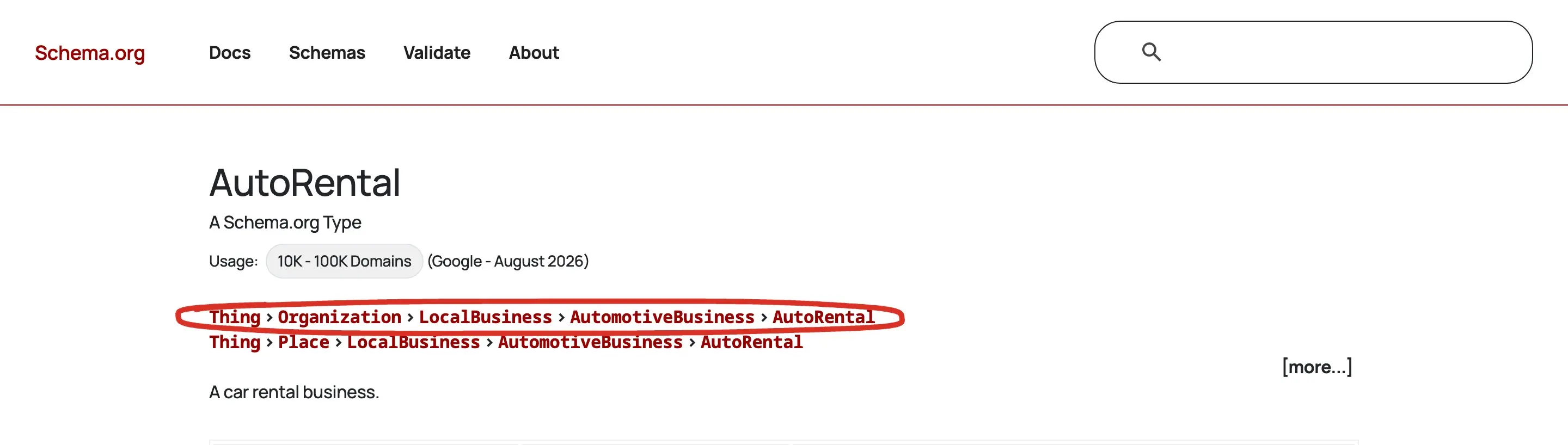 The AutoRental type on schema.org, as I opened it on 7 October 2026. The circled line shows it sits under LocalBusiness, so a car rental can describe itself precisely instead of as a generic "Organization".
What I'd do differently: install analytics on day one. Kokos still has no verified traffic figure, so I can show better pages and nothing about bookings.
Villas and holiday rentals
A villa owner usually has one property and one page that tries to say everything. Split it:
- One page per thing a guest decides on. The villa, the location, how to get there from the airport, the area's beaches. Each answers one search.
- Facts in text, not only in photos. Bedrooms, sleeps, pool size, distance to the nearest beach and supermarket. AI answers and Google can only quote what's written.
- Your own booking route. If the only "Book" button goes to Airbnb, every guest you won with SEO pays the platform's fee.
- A Google Business Profile for the property, with the real address and photos, so it can appear when someone looks at the map of the area.
Aroma Suites in Santorini shows how far a small property can go on its own site. Its accommodation page lists six room types and a private villa, each with its own page and slug. After the new site launched in late March 2026, Search Console recorded 13,603 clicks between February and September 2026, starting from a site that had no Search Console data before the launch. That's clicks from Google, not bookings, and I don't have a booking figure to give you. The full story is in the Aroma Suites case study.
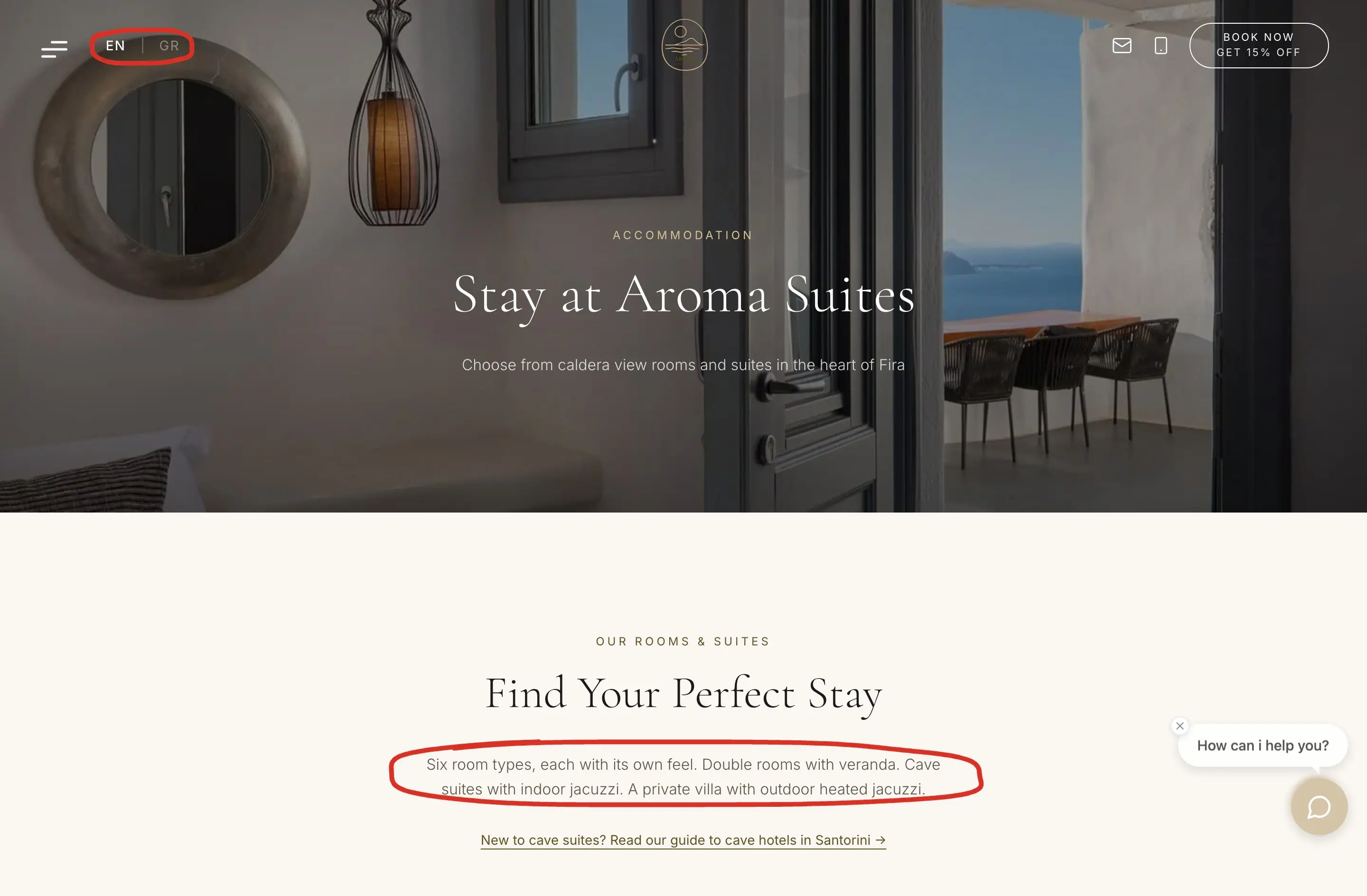 The Aroma Suites accommodation page on 7 October 2026. Two things are circled: the language switch, which keeps guests on the same page in Greek or English, and one plain sentence that tells Google and AI answers what the property offers.
A second example from the same owner: Uma Ray Suites, ten adult-only suites in Fira. According to its homepage, the Book Now button opens the hotel's own booking engine, not an OTA page, and offers 15% off for booking there. That's the booking route I want to see on every property's site.
Tours and activities
Tour operators compete with GetYourGuide, Viator and TripAdvisor for nearly every head term. You won't outrank them on "Samaria gorge tour". You can win what they don't write well:
- Meeting point, pickup areas, duration and what to bring, on the tour page, in text. These are the questions people ask the day before.
- A page per tour, not one page with all of them. Each tour has its own search.
- Guides to the place the tour goes, written from experience: when to go, how crowded it gets, what the road is like. That's the content a marketplace listing doesn't carry.
- Reviews on Google, not only on the marketplace. The map pack reads Google reviews.
Languages: the tourism-specific part
A Greek tourism business sells to people who search in English, German, French and Greek. Two rules cover most of it:
- Translate the pages that sell, not everything. Rooms, cars, tours, prices, how to get there. Blog posts can stay in one language until they earn traffic.
- Tell Google which page is which language. That's hreflang, and Google's documentation says each language version has to list itself and all the others. If the Greek page points to the English one but not back, Google may ignore both.
A language switch that drops the guest on the homepage instead of the same page in the other language loses them. Aroma's switch keeps the page; it's circled in the screenshot above.
Local search and the map
Once a traveller is on the island, the search changes to "car rental near me" or "boat trip Chania" and Google shows the map first. For that, the Google Business Profile matters more than the website: the right category, the real address, opening hours, photos and reviews that keep coming. I cover the setup step by step in local SEO for small business.
One thing tourism businesses get wrong: the name, address and phone number differ between the site, Google, Booking and TripAdvisor. Pick one version and copy it everywhere, character for character.
What to do first, in order
- Check that Google can see your site. Search Console connected, sitemap submitted, every page you care about indexed. If pages are missing, start with how to get your website on Google.
- Fix titles and the H1 on the pages that sell. Place, service, and one reason to book direct.
- Add the right schema type (AutoRental, LodgingBusiness, TouristTrip or a LocalBusiness subtype) with your real details.
- Claim and complete the Google Business Profile.
- Write the five pages guests ask about most, from what you hear on the phone.
- Make it fast on a phone. My WordPress speed guide covers the fixes that took Kokos from 74 to 86. The technical SEO checklist has the rest.
- Ask every happy guest for a Google review, the same week.
Most small operators can do steps 1 to 4 of tourism SEO in a week. Steps 5 to 7 don't end.
FAQ
What is tourism SEO?
It's search optimisation for travel businesses: making a car rental, villa, hotel or tour easy to find for someone searching before or during their holiday. For a small operator that means a crawlable site in the right languages, a complete Google Business Profile, pages that answer guests' questions, and reviews.
Is SEO worth it for a small car rental or villa?
Yes, if you take bookings directly. Tourism SEO pays back per booking: every guest who finds you in Google instead of on a platform is a booking without commission. It takes months, so it works alongside the platforms, not instead of them at first.
Can I outrank Booking.com or GetYourGuide?
Not on the big generic searches. You can win the specific ones: your area plus your service, the questions guests ask, and the map for "near me" searches.
How long does tourism SEO take?
Technical fixes and the Google Business Profile can be done in days. Rankings for new pages usually take months, and in tourism they also follow the season, so start before it.
Should a hotel follow the same steps?
Mostly, plus the booking engine, OTA listings and rate parity. I cover those in my hotel SEO service, and if the site itself needs rebuilding, there's my page on hotel websites (in Greek).
Working with me
I'm Panagiotis Karampetsos, a developer and SEO based in Heraklion, Crete. I build and fix sites for tourism businesses on WordPress and Next.js, and I do the SEO on the same sites, so the fixes don't wait for someone else. If you run a car rental, villa or tour business, send me two lines with your site and what you want more of, and I'll tell you what I'd fix first.