AI Automation for Small Business: What's Worth Automating (and What Isn't)
AI automation for small business, from someone who builds it: the jobs worth automating, the ones that aren't, what it costs to run and how to start.

Short answer
AI automation for small business works when you give it one repetitive job that eats hours every week, ground it in your own information, and keep a person in charge of the exceptions. It doesn't work when you buy a tool first and look for a job for it later.
The jobs I'd automate first in a small business:
- Answering repeat customer questions on your website and by email
- The first reply to new enquiries, with the qualifying questions asked for you
- Reading and matching documents: invoices, delivery notes, forms
- Finding answers in your own files: procedures, manuals, price lists
- Recurring reports pulled together from the tools you already use
The jobs I wouldn't automate: anything that happens rarely, anything where every case is a judgement call, and any process that's already a mess when done by hand.
I build AI systems for small and mid-sized businesses from Heraklion, Crete: chatbots on hotel websites, document matching for a retail chain, and the agent platform they run on. This is what I've learned about where AI automation pays in a small business and where it doesn't.
AI for small business: why your position is different
Most guides about AI for small business are written by big software companies, and the advice fits a company with an IT department. A small business has other constraints:
- No one owns "AI". The owner, or one busy person, has to find the time.
- Fewer cases per job. A small family hotel doesn't get the volume of a hotel chain, so the savings per automation are smaller.
- Less tolerance for risk. One wrong answer to a regular customer hurts more.
- Tighter budgets, and less patience for long projects.
You do have one advantage. Decisions are short and processes are simple, so one automation can go live fast and everyone can see quickly whether it works.
Adoption is still early. Eurostat reported on 11 December 2025 that 20.0% of EU enterprises with 10 or more employees used AI technologies in 2025. Most businesses haven't started, and the ones that start with a clear job have room to get ahead.
 Eurostat's release, captured 6 October 2026: one in five EU businesses of that size used AI in 2025, so most still haven't.
Where AI automation for small business pays
Answering repeat customer questions
Every small business answers the same questions again and again. A chatbot on your website, grounded in your own content, can answer them at any hour and hand the rest to you.
This is the build I do most. Chatbots I set up are live on Aroma Suites, Casa di Terra Villa and Amoopi Nymfes (checked 23 September 2026). They answer from each hotel's own site and documents, and pass complaints, refunds and complex booking changes to staff. If you run a hotel, my hotel chatbot guide goes into the details.
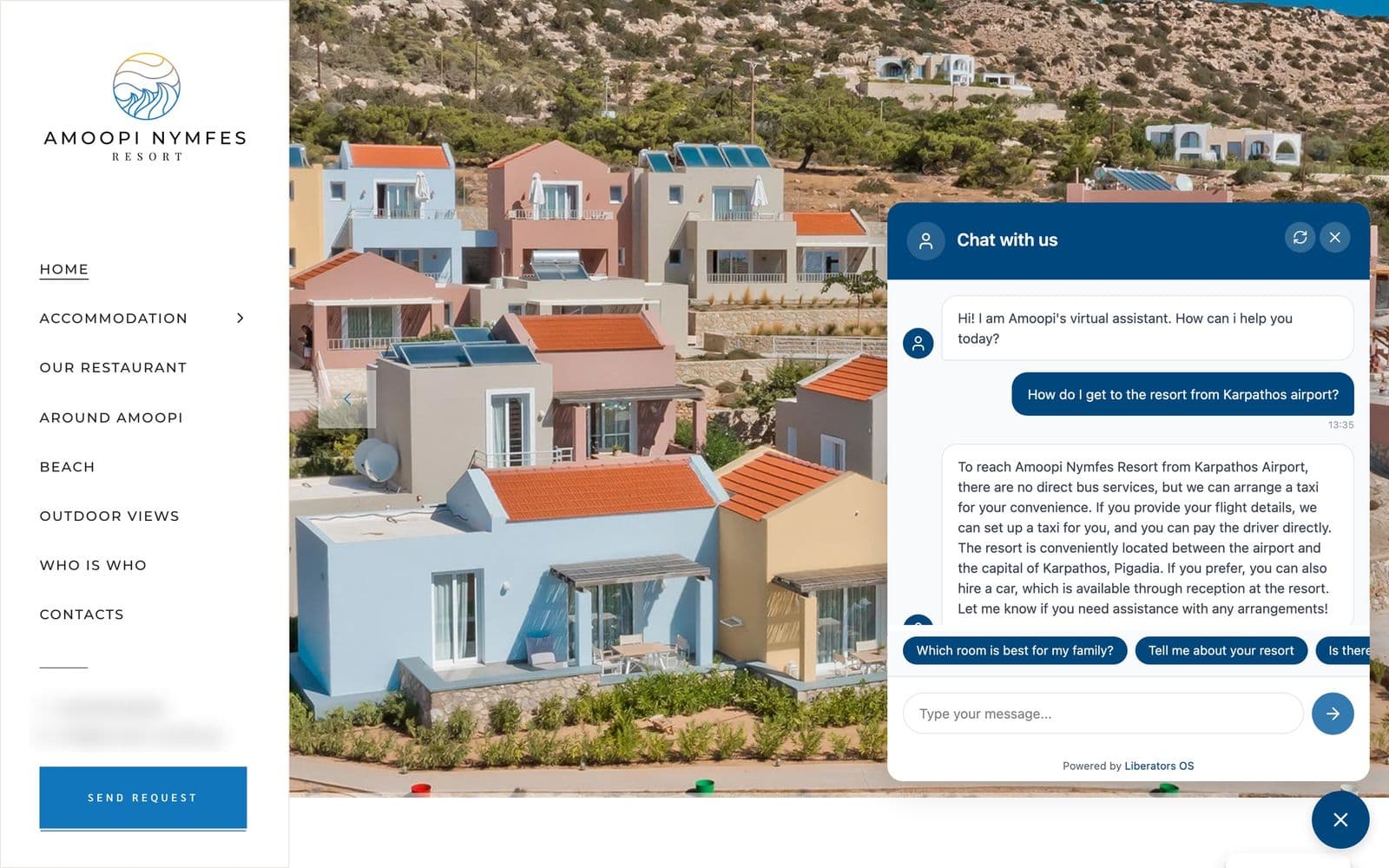 Asked on the live site on 23 September 2026. The answer comes from the resort's own information, including what the resort arranges for guests.
Worth it when: you get the same questions every week and your website content is correct.
The first reply to new enquiries
A chatbot on your site can handle the first conversation with a visitor: answer the service questions, ask the qualifying ones and pass the enquiry on. You get a lead with the basics already answered instead of a bare "please call me".
Worth it when: leads arrive outside working hours, or the first reply is always the same few questions.
Reading and matching documents
Paperwork eats hours that nobody tracks. For a Greek supermarket chain with 175 stores, I built a pipeline that reads scanned delivery notes and invoices, including the Greek receipt dates on the warehouse stamps, and matches them automatically, flagging mismatches for a person.
A smaller business won't have that volume, but the pattern scales down: supplier invoices against orders, forms against a checklist, receipts against bank lines.
Worth it when: someone spends hours each week reading documents and copying or comparing fields.
Finding answers in your own files
Every business has knowledge stuck in PDFs, spreadsheets and one experienced person's head. For a shipping company, I built a system where staff upload a vessel's Excel template of machinery and equipment items. It searches that vessel's manuals and equipment registers, fills in the matching entries and shows the source file and row for each one. Anything it rejected is listed with the reason. The same approach works for a price list, a procedures manual or staff policies.
Worth it when: people keep asking the same colleague where something is written.
Recurring reports
Weekly numbers from the booking system, the CRM and the inbox, pulled into one summary. This is usually more plain automation than AI, with a model writing the summary at the end. Connector tools like n8n, Zapier or Make handle the plumbing well.
Worth it when: someone builds the same report by hand every week.
For more, see the AI automation examples I've built, with what each one replaced.
Where it isn't worth it (yet)
Being honest about the limits of AI for small business saves you money.
Low volume. If a job happens five times a month, the build won't pay back. Do it by hand.
Every case is a judgement call. Pricing a custom quote, handling an upset regular customer, deciding on a refund. AI can gather information; a person should decide.
The process is broken. If nobody agrees how the job should be done, automating it makes the confusion faster.
Nobody will maintain it. Prices, policies and opening hours change. If no one updates what the AI reads, it starts giving wrong answers.
Your information isn't written down. The AI can't answer from knowledge that only lives in your head. Write it down first. That's useful even without AI.
What AI automation for small business costs
Two parts: building it and running it.
Running costs are mostly model usage, and they're lower than most owners expect. Per Anthropic's published API prices (checked 6 October 2026), Claude Haiku 4.5 costs $1 per million input tokens and $5 per million output tokens. For a customer conversation that uses 5,000 input tokens and 1,000 output tokens, that works out to about one cent. Add the platform or hosting the system runs on.
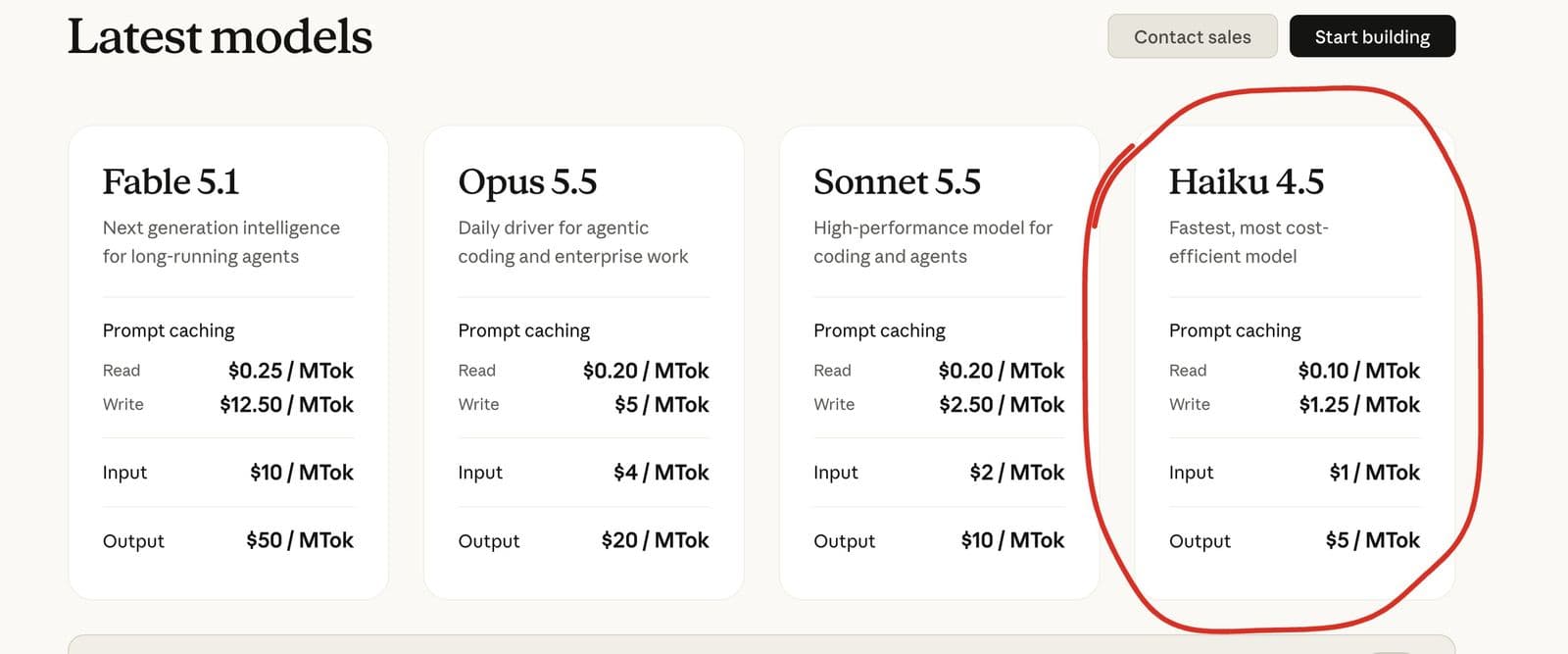 Anthropic's public API prices on 6 October 2026: Haiku, the model in the one-cent example, is the cheapest card on the page.
Building costs depend on the job. Configuring a chatbot on an existing platform with your content is a small project. A custom document pipeline that connects to your own systems is a bigger one. I price after I've looked at the process, not before, because that's when I know what the build involves.
The cost people forget is time. Someone has to test the system on real cases before launch, and keep its information current after. Budget a few hours a month for that.
Before you commit, run the numbers. My AI ROI guide has a worked example you can copy with your own figures.
Tools or custom build?
For a small business, start with the cheapest thing that does the job.
| Situation | What I'd use |
|---|---|
| A standard job, and a tool already does it well | Buy the tool |
| A common job (website chatbot, document Q&A) that needs your content and rules | Configure an agent platform |
| Moving data between apps you already use | A connector tool like n8n, Zapier or Make |
| An edge case no tool handles, or a job that spans your own systems | Custom build |
Research backs the "buy first" part. MIT NANDA's The GenAI Divide: State of AI in Business 2025 found that AI tools bought from specialised vendors succeeded about 67% of the time, while internal builds succeeded about a third as often (as reported by Fortune, 18 August 2025). I build custom systems for a living, and I still tell clients to buy when a tool fits.
How to start: a plan for your first automation
- List your repetitive jobs. Everything your team does every week that follows a pattern.
- Estimate the hours. How often, how long each time, who does it. Then split the job into steps, as in AI process automation.
- Pick one job with the most hours and the clearest right answer.
- Collect a few dozen real examples of that job, messy ones included.
- Check for a ready tool. If one fits, try it on your real examples.
- If nothing fits, build the smallest version that does the whole job for those examples.
- Decide the handoff: which cases go to a person, and how.
- Label the AI. Under Article 50 of the EU AI Act, which applies from 2 August 2026, people must be told they're talking to an AI system unless it's obvious.
- Measure after a month or two against the hours you wrote down in step 2.
The full version of this process is in my guide to AI implementation.
What to expect
Don't expect AI automation for small business to run the company. Expect it to take specific hours off specific jobs.
Independent research puts general use in perspective. According to a Federal Reserve Bank of St. Louis analysis published 27 February 2025, workers using generative AI saved 5.4% of their work hours on average, about 2.2 hours of a 40-hour week. A study of customer support agents found a purpose-built AI assistant raised issues resolved per hour by 14% (NBER working paper 31161).
So chatting with a general AI tool saves you some time (here's where ChatGPT for small business helps, and where it stops). The bigger savings, when they come, come from one tool built into one specific job.
FAQ
What is AI automation for small business?
It's using AI systems to do repetitive work in a small business, like answering customer questions, qualifying enquiries, reading documents or finding answers in your files, with a person handling the exceptions. It combines regular automation with a model that can read and write.
What can a small business automate with AI?
The best starting points are answering repeat customer questions, the first reply to new leads, matching invoices and other documents, searching your own procedures and price lists, and recurring reports. Pick the one that eats the most hours each week.
How much does AI automation cost for a small business?
Running costs are mostly model usage. Claude Haiku 4.5 costs $1 per million input tokens and $5 per million output tokens (source: Anthropic pricing), so a typical customer conversation comes to around one cent. Build costs depend on whether you buy a tool, configure a platform or need a custom system.
What is the best AI for a small business?
There's no single best one. For chat and writing, the main models from OpenAI, Anthropic and Google all work. What matters more is grounding the AI in your own information and giving it one clear job. Test more than one model on your real questions.
Which AI automation agency is best for small businesses?
Look for one that asks about your process before it talks about tools, tests on your real examples, shows systems it has built and you can see live and tells you when to buy a tool instead. Be careful with anyone who promises savings before measuring your current process.
Do I need technical staff to use AI automation?
No, but you need someone who owns it: a person who knows the process, checks the results and keeps the information the AI reads up to date. The build itself can come from a tool or an outside builder.
Where to start
Write down the job that eats the most hours in your week. Then talk to someone who'll tell you honestly whether to buy a tool or build. Before that call, read what to ask an AI developer.
That's how I work as an AI automation consultant. You can see what I've built on my portfolio, or send me the job you'd like off your plate.