ChatGPT for Small Business: What It Does Well and Where It Stops
ChatGPT for small business without the hype: where it helps, which plan you need, what to watch with your data, and when to build your own system.

Short answer
ChatGPT for small business is the cheapest place to start with AI. It drafts and translates from the first day, and there's nothing to set up. It stops at a clear line, though: on its own it doesn't run anything inside your systems, and it doesn't answer your customers while you're away.
I build AI systems for businesses, and a lot of them started with someone who had already tried ChatGPT and hit that line. This article is about where exactly the line sits for a small business, and what to do once you reach it. For the bigger picture, read my guide to AI implementation.
What ChatGPT is, in one paragraph
ChatGPT is OpenAI's chat app, built on a large language model. You type, it answers. It learned from a huge amount of text, so it writes well and knows a little about everything. It knows nothing about your business except what you give it: what you paste into the chat, the files you upload, and, on the business plans, the company apps you connect.
What ChatGPT for small business is good at
These are the jobs where I see ChatGPT pay off from the first day:
- First drafts: quotes, email replies, product or room descriptions, social posts. You still edit, but you don't start from a blank page.
- Translation. A hotel in Crete that answers guests in German, French and Italian saves a lot of effort. Someone who speaks the language should still check anything that goes to a customer.
- Summaries of long documents. A contract, a tender, a long email thread. It tells you what's in there, and you check the parts that matter.
- Spreadsheet formulas. You describe what you want to calculate, it writes the formula.
- A second brain for planning. It asks you questions about a plan, finds holes in a proposal, argues the other side.
In every one of these, a person sits at the screen and checks what came out.
Where ChatGPT stops
It only knows what you hand it
Ask "what time is check-in at our hotel" and it has no idea. You can paste in text, upload files or, on the business plans, connect Google Drive or Microsoft 365. That helps the person asking. It doesn't help a guest on your website at 2 a.m.
It doesn't run on its own inside your systems
It won't post invoices into your accounting software or reply to visitors on your site. Those jobs need a workflow that runs without someone pushing it, with your rules and your checks. That's AI automation for small business, not a chat window.
It can be wrong with total confidence
Language models write a wrong answer in the same tone as a right one. In a customer email, a price or anything legal, that costs money. Whatever goes out the door, a person reads first.
Everyone on the team uses it differently
Five people using it five ways get five levels of quality. A system gives everyone the same instructions and the same data.
Which ChatGPT plan does a business need?
Start with the free plan. For one person it's often all you need, and it shows you whether ChatGPT helps with your work at all before you spend anything.
Move to ChatGPT Business once a team uses it every day. It's OpenAI's own ChatGPT for business plan, and OpenAI's pricing page lists what changes: a shared workspace, admin controls and billing in one place, connections to tools like Microsoft 365, Google Drive and Slack, and "no training on your business data by default". According to OpenAI's pricing page, when I checked from Greece on 7 October 2026, Business cost €21 per user per month on yearly billing and €26 on monthly billing, for 2 or more users. OpenAI shows prices in your local currency, so in the US you'll see dollars. Open the page for yours.
ChatGPT Enterprise is custom-priced through OpenAI's sales team and adds things a small business rarely needs, like data residency and custom retention rules. If you're reading a blog post to decide whether you need it, you don't need it yet.
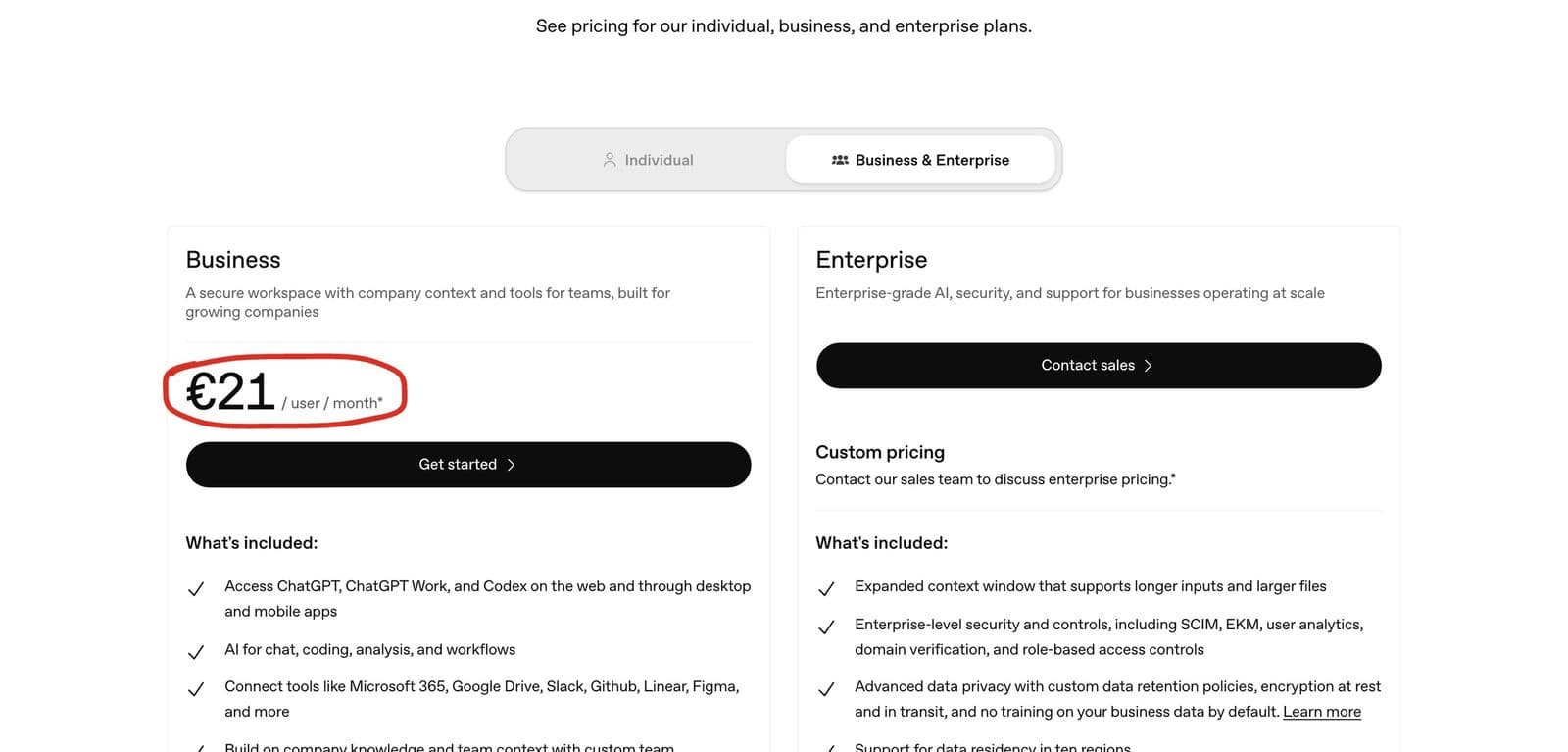 The Business tab of OpenAI's pricing page on 7 October 2026, seen from Greece. The circled price is per user, so a team of five pays five times that.
ChatGPT or your own AI system?
ChatGPT is enough when you work with it yourself, one task at a time. You need your own system when the work has to run by itself, on your data and inside your software.
| ChatGPT | Your own AI system | |
|---|---|---|
| Knows your data | What you paste, upload or connect | Reads your documents, website or database every time |
| Runs by itself | No, a person starts each task | Yes, triggered by an email, a form or a file |
| Works inside your software | Limited | Yes: CRM, booking engine, ERP |
| Shows where each answer came from | Not always | Can point to the file and the line |
| Setup | One day | Weeks |
| Cost | Subscription per user | Build cost plus usage |
Two of my projects show the difference better than the table does.
For a shipping company I built a system around the Excel templates of its vessels. You upload a vessel's template, the list of its machinery and equipment. The system searches that vessel's manuals and equipment registers, finds the matching records and writes them into the cells, along with the file and the row each one came from. Records it checked and rejected go into a separate list with the reason, for example a name that didn't match. With ChatGPT, someone would have to upload the right files for every vessel and check each row by hand, without knowing which file a value came from, or whether it came from no file at all.
At Aroma Suites, Casa di Terra Villa and Amoopi Nymfes, chatbots I built answer guests around the clock from each property's own content. ChatGPT can't sit on your website and answer on its own. A system can. More builds like these are in my list of AI automation examples.
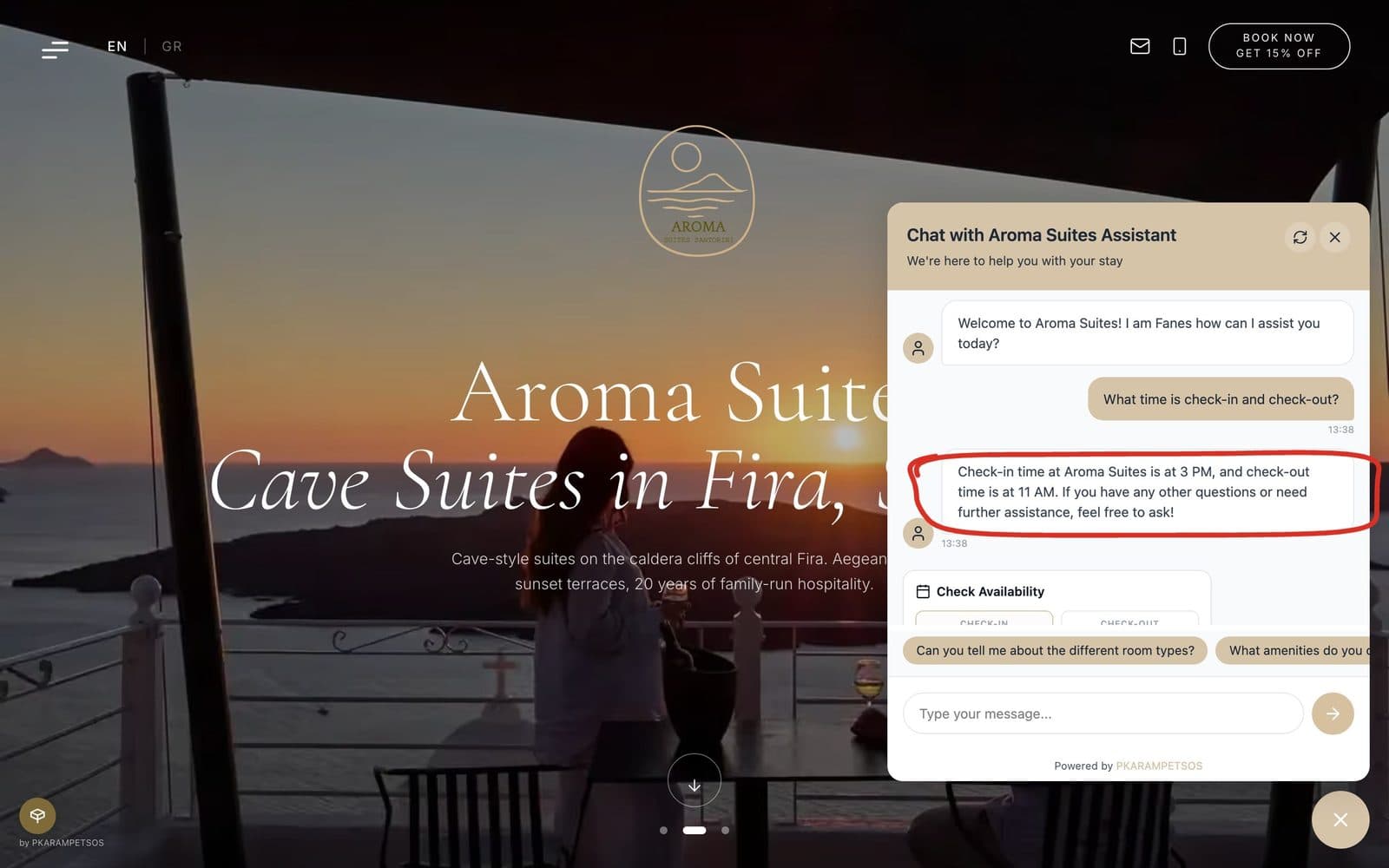 The question ChatGPT can't answer, "what time is check-in?", answered in the circle by the hotel's own chatbot from the hotel's own website.
How to use ChatGPT for business safely
Your team probably uses it already. Set three rules:
- No customer personal data in personal accounts. Names, phone numbers, card numbers, health details. If you need ChatGPT on customer data, use a business plan and read OpenAI's data terms before you decide. If you have customers in the EU, GDPR applies whatever tool you use.
- A person checks anything that goes to a customer. No exceptions for prices, availability or terms.
- One shared instruction document. Write down your tone, the key facts about your business and what you never say. Every conversation starts from there.
If you put any chatbot in front of customers, they need to know they're talking to a machine. For businesses serving people in the EU this is a legal duty: according to the European Commission, the AI Act's transparency rules apply from 2 August 2026. Outside the EU it's still the honest thing to do.
When it's time for more than ChatGPT
Signs that ChatGPT isn't enough anymore:
- Someone on your team copies and pastes in and out of ChatGPT all day. That copy-paste is the job worth automating.
- You need answers from your own documents and you need to know where each answer came from.
- You want something to answer your customers while you sleep.
If one of these sounds familiar, that's the work I do as an AI automation consultant. I start by sitting with you and the person who does that copy-paste, before anyone picks a tool.
FAQ
Is it worth getting ChatGPT for business?
For a small business, yes, for work where a person writes, translates or summarizes and checks the result. Using ChatGPT for small business work like this is the cheapest way to find out what AI can do for you before you pay for anything else.
Which ChatGPT plan is best for business?
For one person, the free plan or Plus. For a team that uses it daily, ChatGPT Business, because it adds a shared workspace, admin controls and no training on your business data by default. Enterprise is for companies that need custom security and contracts.
How much does ChatGPT cost for a business?
The free plan costs nothing. ChatGPT Business is priced per user per month with a minimum of 2 users, and OpenAI shows the price in your local currency on its pricing page. Enterprise is custom-priced.
Can ChatGPT answer customers on my website?
Not on its own. For a chatbot to answer on your site from your own information, you need a system that reads your content and runs on the site. That's what I've set up for hotels like Aroma Suites.
Is it safe to put business data into ChatGPT?
It depends on the account and the data. Keep customer personal data out of personal accounts. On ChatGPT Business, OpenAI says it doesn't train on your business data by default, but read its data terms and check your own legal obligations before you rely on it.
What's the difference between ChatGPT and an AI system?
ChatGPT is a conversation: you ask, it answers from what it knows in general and what you give it. An AI system reads your own data, runs by itself and works inside your software, with checks you set.
If you've hit the limit of ChatGPT and want to see what a system on your own data would take, tell me what your team copies and pastes today. More about what I build is in my portfolio.