How to hire an AI developer in Greece (and what to ask)
Hiring an AI developer in Greece? The questions to ask, the red flags, freelancer vs agency vs Big Four, and how to check the proof yourself.

Short answer
If you want to hire an AI developer in Greece, start with the job you want done, not with a job title. Write down which task eats hours, who does it today and what goes wrong when it's late. Then ask every candidate the same questions, and open their live work yourself before you sign anything.
I'm Panagiotis Karampetsos, an AI developer based in Heraklion, Crete. I build AI agents, systems that read your documents and the websites around them. This is the guide I'd like every buyer to read before they talk to me or to anyone else, including the questions that would make me look bad if I couldn't answer them.
Start with the job, not the title
"AI developer" covers people who do quite different work. One connects a chatbot to ChatGPT and stops there. Another builds a system that reads your supplier invoices, checks them against delivery notes and flags the mismatches. A third trains machine learning models and has never spoken to a hotel receptionist.
You don't need to know which one you need. You need to describe the work well enough that the right person recognises it. Three lines are enough:
- The task: "We match supplier invoices to delivery notes by hand."
- Who does it: "Maria in accounts, about two days a week." Use your own estimate here, not mine.
- What goes wrong: "Mismatches get caught a month late, after we've paid."
Hand that to three candidates. The good ones will start asking about Maria. The weak ones will start talking about models.
Freelancer, agency or Big Four: which one fits
In Greece you'll mostly choose between three kinds of seller. None of them is the right answer for everyone, and I'm one of the three, so read this part with that in mind.
| Freelance AI developer | Greek AI agency | Big Four consultancy (Deloitte, PwC, EY, KPMG) | |
|---|---|---|---|
| Who you talk to | The person who builds it | An account lead, then a team | Partners and managers, then a delivery team |
| Good fit | One clear problem in a small or mid-sized business | Several systems at once, or support across shifts | Large organisations, regulated sectors, board-level programmes |
| Watch for | What happens if that one person is ill or busy | Whether the people on the call build anything | Whether the budget goes on slides before software |
When not to hire a freelancer, me included:
- You need someone on call around the clock for a system that can't stop. One person can't promise that.
- You want several systems built in parallel in the next quarter. That's a team's job.
- Your procurement rules require a company with a set number of staff, insurance or certifications.
- You need an audit or compliance sign-off for a regulator, not only a working system.
If none of those apply, a freelancer is often the faster route: the person who hears your problem is the person who writes the code, so nothing gets lost between a salesperson and a developer.
The questions to ask before you hire an AI developer
Ask these on the first call. You'll learn more from how someone answers than from their portfolio.
"Can I open something you built that's running today?"
Not a video, not a demo on their laptop. A live system you can use from your own phone. If everything they've built is "under NDA", ask for a reference you can call instead.
"Who will I actually work with?"
Make sure the person on the call is the person who builds it, or meet the person who will.
"Will you sit with the person who does this job now?"
This is the question I'd put first. The owner knows why a process exists. The person who does it every day knows where it breaks. An AI developer who only talks to the owner will build the process as the owner imagines it.
"What does the system do on its own, and what waits for a person?"
A good answer names specific steps. "The agent drafts the reply, a person approves it before it's sent" is an answer. "It's fully autonomous" isn't.
"Where does my data go, and which AI model sees it?"
You should get a plain answer: which provider, which country, what's stored and for how long. If the system handles customer data, it also has to work within GDPR.
"How will people know they're talking to an AI?"
Under Article 50 of the EU AI Act, the transparency rules apply from 2 August 2026: people must be told when they're interacting with an AI system. Ask how the developer handles that in a chatbot or an email assistant. If they've never heard of it, that tells you something.
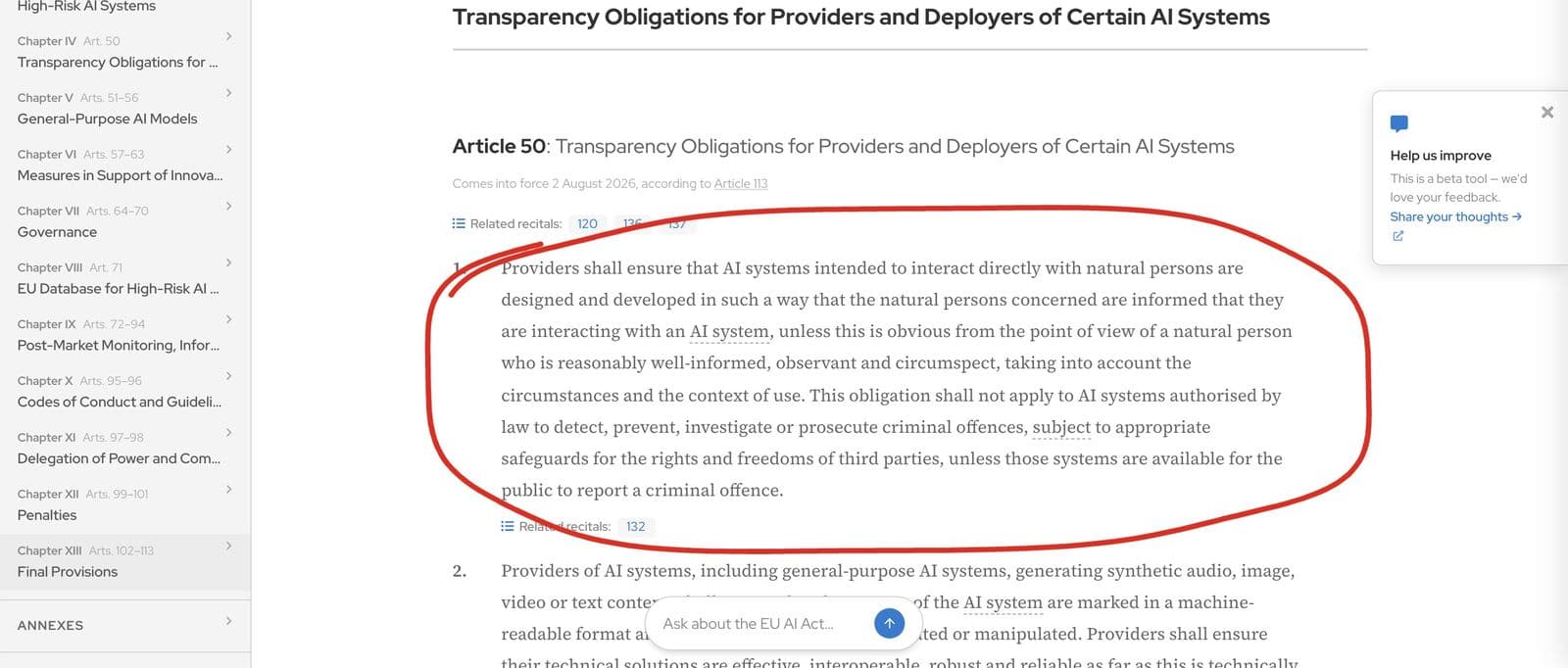 Article 50, paragraph 1: the rule a chatbot on your website has to follow. Ask any developer how they meet it.
"What happens when it gets something wrong?"
It will. Ask how mistakes get noticed, who sees them, and how the system improves afterwards.
"Does it work in Greek?"
Greek customers write in Greek, in Greeklish and in English, sometimes in the same message. Greek documents come with handwritten dates and stamps. Ask to see Greek input handled, not only English.
"How will my team learn to use it, and what happens after launch?"
A system nobody trusts ends up unused. Ask who trains your people, how, and who you call when something changes in your business.
Red flags
- A promised saving in hours or euros before they've seen how you work.
- No live system you can open, only slides or a recorded demo.
- "Fully autonomous" for anything that touches customers or money.
- No plan for after launch.
- They can't explain the system in plain words to the person who'll use it.
- Pressure to decide on the first call.
How to check the proof yourself
Proof you can open beats any case study PDF. Here's what you can check on my work today, without asking me for anything:
- Three live chat assistants on hospitality websites, all running on Liberators OS, the AI agent platform I built: Casa di Terra Villa, Amoopi Nymfes and Aroma Suites. Open one and ask something a guest would ask. Then ask something odd, and see how it copes.
- The platform itself at os.liberators.ai, the public page of the system those assistants run on.
- Work you can't open, described honestly: a system for a supermarket chain with 175 stores that reads invoices and delivery notes, including handwritten Greek dates; and one for a shipping company that matches a vessel's equipment list to its manuals and registers, citing the source file and line for every match. For work like this, ask for a reference call.
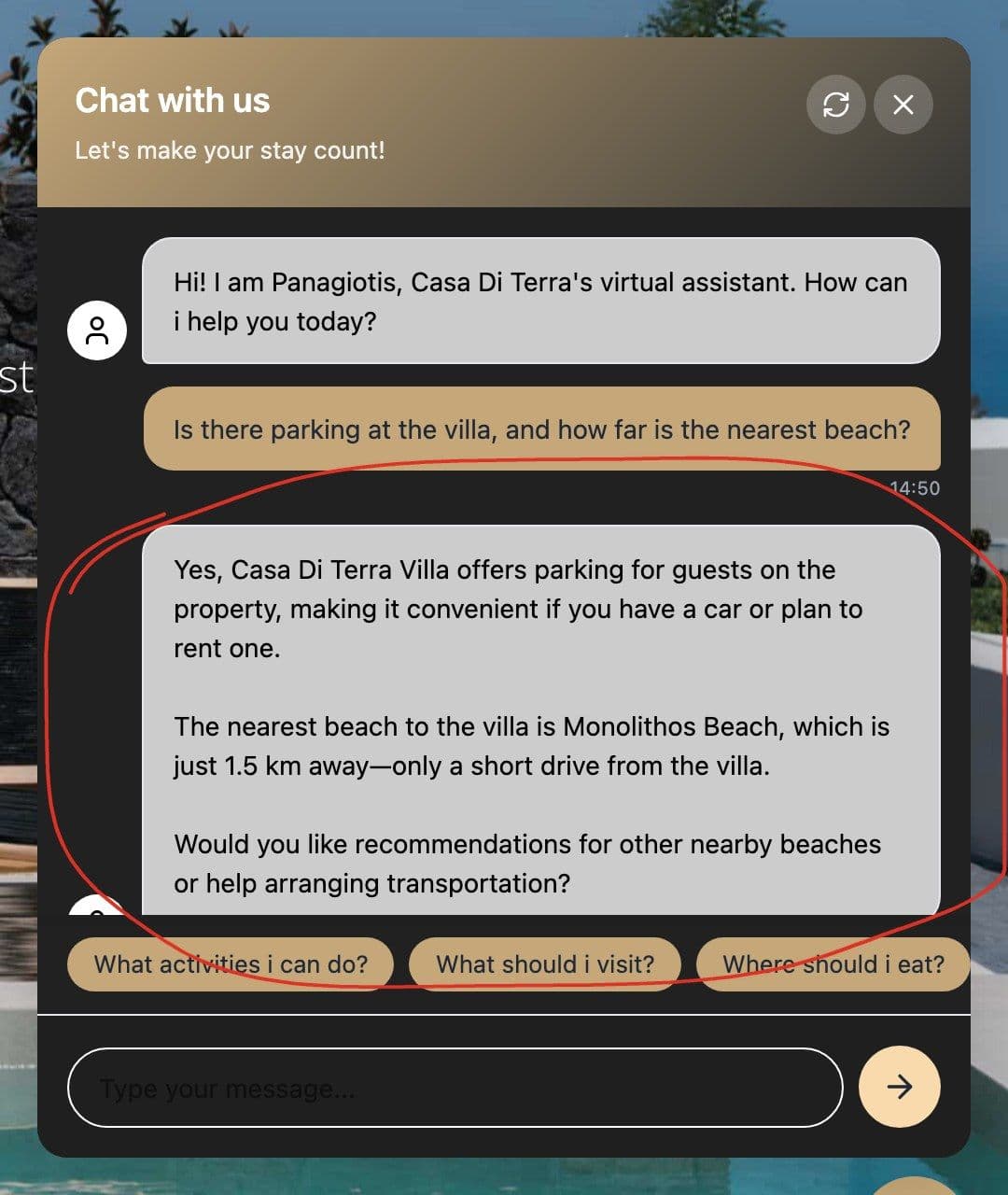 A real answer from the live assistant, asked the week I wrote this. Open the site and ask it something of your own.
Do the same with anyone else you're considering. If you're still comparing names, I've written a separate comparison of AI automation consultants in Greece, with criteria and who each one suits.
How I work
The method matters more than the tools, so here's mine.
- Working sessions, not a questionnaire. I sit with you and with the person who does the job, and we go through it together on the real screens and the real documents.
- The agent drafts, a person approves. Wherever the system touches a customer, a payment or a decision, a person signs off. The system saves the typing. The call stays with your people.
- Continuous contact until it's stable. I stay close after launch, adjusting as your team uses it, until it runs without me checking it every day.
- Training in three stages. First, setting up and organising things properly. Then, using AI in the daily work. Then the advanced uses, once the team is comfortable.
If you want the longer version of how a project runs from idea to production, I've written an AI implementation guide. For what this looks like as a service, see my AI automation consultant page.
What a first call with me looks like
- You describe the job in your own words. I ask who does it today and what goes wrong.
- I tell you if AI is the wrong tool. Sometimes a better form, a spreadsheet rule or a change in who does what solves it, and you don't need me.
- If it fits, the next step is a working session with the person who does the job.
- After that you get a written summary: what I'd build, what stays with a person, what I need from you, and how we'd know it's working.
No pressure to decide on the call. You can see more of my work on the portfolio.
FAQ
How much does it cost to hire an AI developer in Greece?
It depends on the job, the data and how much of it a person still checks. I don't quote before a working session, because a number given before I've seen the work is a guess. After the session you get a written scope, and the price follows from that.
Can I use ChatGPT instead of hiring an AI developer?
Often, yes, for one person's writing and research. You need a developer when the AI has to work inside your systems: read your documents, answer customers from your own information, or pass work between tools without someone copying and pasting. My guide on AI automation for small business goes through where that line sits.
Does the AI developer need to be in Greece?
Not for the build. Most of the work runs remotely. What helps is someone who can sit with your team for the working sessions, speaks Greek, and knows how Greek documents and customers behave. I'm in Heraklion and work with businesses across Greece and abroad.
What's the difference between an AI developer and an AI consultant?
A consultant tells you what to build. A developer builds it. The useful ones do both, and stay to make sure it's used. If someone only advises, ask who will build what they recommend.
Want to talk it through?
Tell me the job you'd like to take off your team's hands, in three lines like the ones above. Send me the job description, and I'll tell you honestly whether AI is the right tool for it.