How to Rank in ChatGPT: What I Measured on My Own Site (Starting From Zero)
How to rank in ChatGPT, from my own measurement: where I start (0 of 18 answers), what AI cites instead of my site, and what I changed.

Short answer
How to rank in ChatGPT, in short: you need two things. AI search crawlers must be allowed to read your site, and the sources AI trusts (directories, review platforms, marketplaces, other people's lists) must mention you, consistently, under the same name and details. Your own pages matter, but on "who should I hire" questions, AI answers lean mostly on third-party sites.
I know that last part because I measure it on my own site, and my starting point isn't good. On 6 October 2026, I asked six "who's the best" questions about my own field, three times each, and pkarampetsos.com appeared in 0 of 18 answers. Below is how I measure it, what the AI cited instead, and what I've changed since. It's a starting line, not a success story.
Can you rank in ChatGPT the way you rank in Google?
Not in the same sense. Google has positions. ChatGPT and other AI tools write a new answer every time, and the brands in it change from run to run.
SparkToro tested this with 2,961 prompts across ChatGPT, Claude and Google's AI, and found less than a 1-in-100 chance of getting the same list of brands twice, according to Search Engine Journal's report on the SparkToro study.
So "ranking" in ChatGPT means being mentioned often across many runs of the same question. That's why I don't check it once by hand. I measure a frequency.
How I measure whether I rank in ChatGPT
I keep two fixed sets of questions and ask them repeatedly through an AI search API, counting two different things:
- Cited: my site appears among the answer's sources.
- Mentioned: my name appears in the text of the answer.
The first set has 22 questions: mostly what people ask when they're looking to hire ("Who can build a website for my hotel in Greece?", "Ψάχνω ειδικό SEO στην Κρήτη. Ποιον προτείνεις;"), a few information questions like "How much does a hotel website cost?", and two questions about me by name. The second set, added on 6 October, has six "who's the best" questions, in English and Greek, such as "What are the best web design companies in Heraklion, Crete?".
Each question runs three times, because a single answer tells you almost nothing.
Where I start: the numbers
| Date | Question set | Engine | Answers | Cited | Mentioned |
|---|---|---|---|---|---|
| 5 Sep 2026 | 22 main questions | Perplexity | 66 | 20 | 0 |
| 5 Sep 2026 | same 22, four engines | ChatGPT, Perplexity, Gemini, Claude | 88 | 8 | not counted |
| 5 Oct 2026 | 22 main questions | Perplexity | 66 | 3 | 0 |
| 6 Oct 2026 | 6 "best of" questions | Perplexity | 18 | 0 | 0 |
These are my own measurements, kept in my project files; the numbers come from my measurement logs, not from a public tool.
Three things stand out, and none of them flatter me.
ChatGPT cited me only when asked about me by name. In the September run across four engines, ChatGPT cited my site in 2 of 22 answers, and both were the questions that name me. Gemini and Claude cited me in none.
The October drop isn't explained yet. Perplexity cited my site in 20 of 66 answers in September and 3 of 66 in October, and October's three were all on the question about me by name. In between I edited the page that used to get cited most (a corrected figure, a shorter description), the engine may have changed, and the sources it reads may have too. I'm checking which, and I won't guess in public before I know.
On "who's the best" questions, I'm not there at all. 0 of 18. Not cited, not mentioned.
What ChatGPT and other AI cite instead
This is the useful part of measuring, because it tells you what to do.
In the September four-engine run, 94.6% of the sources the answers leaned on were independent sites, led by upwork.com, freelancer.com and clutch.co. Personal and company websites, mine included, were a small slice.
In the October "best of" run, the most-cited domains were clutch.co, designrush.com, goodfit.gr and aisuperior.com. Directories and lists, again.
When my site did get cited in September, it was on questions where I had a specific, useful page: "How much does a hotel website cost?" pulled my hotel website cost guide, and "Are AI chatbots worth it for hotels?" pulled my hotel chatbot guide. So own content wins citations on information questions. On hire questions, the list sites win.
How to rank in ChatGPT: what I'm doing about it
1. Let the AI crawlers in
If OpenAI's crawlers can't read your site, ChatGPT search can't cite it. OpenAI says sites that opt out of its search crawler won't be shown in ChatGPT search answers, according to OpenAI's crawler documentation. Training (GPTBot) and search (OAI-SearchBot) are separate switches.
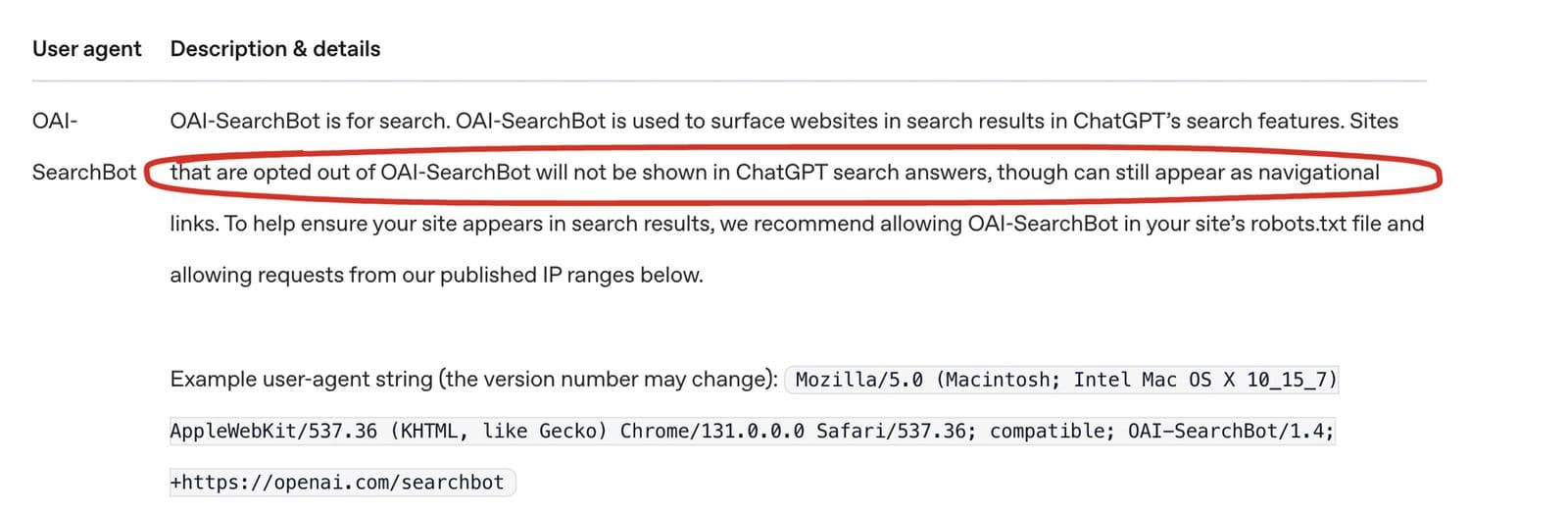 OpenAI's own wording, 6 October 2026, shown with wider line spacing so the loop fits. Blocking the search crawler removes you from ChatGPT's search answers.
On my site, robots.txt allows all of OpenAI's agents and the other AI crawlers explicitly. Many sites block them without the owner knowing, through a CDN setting or a security plugin. Check yours: it's the cheapest fix in this whole article.
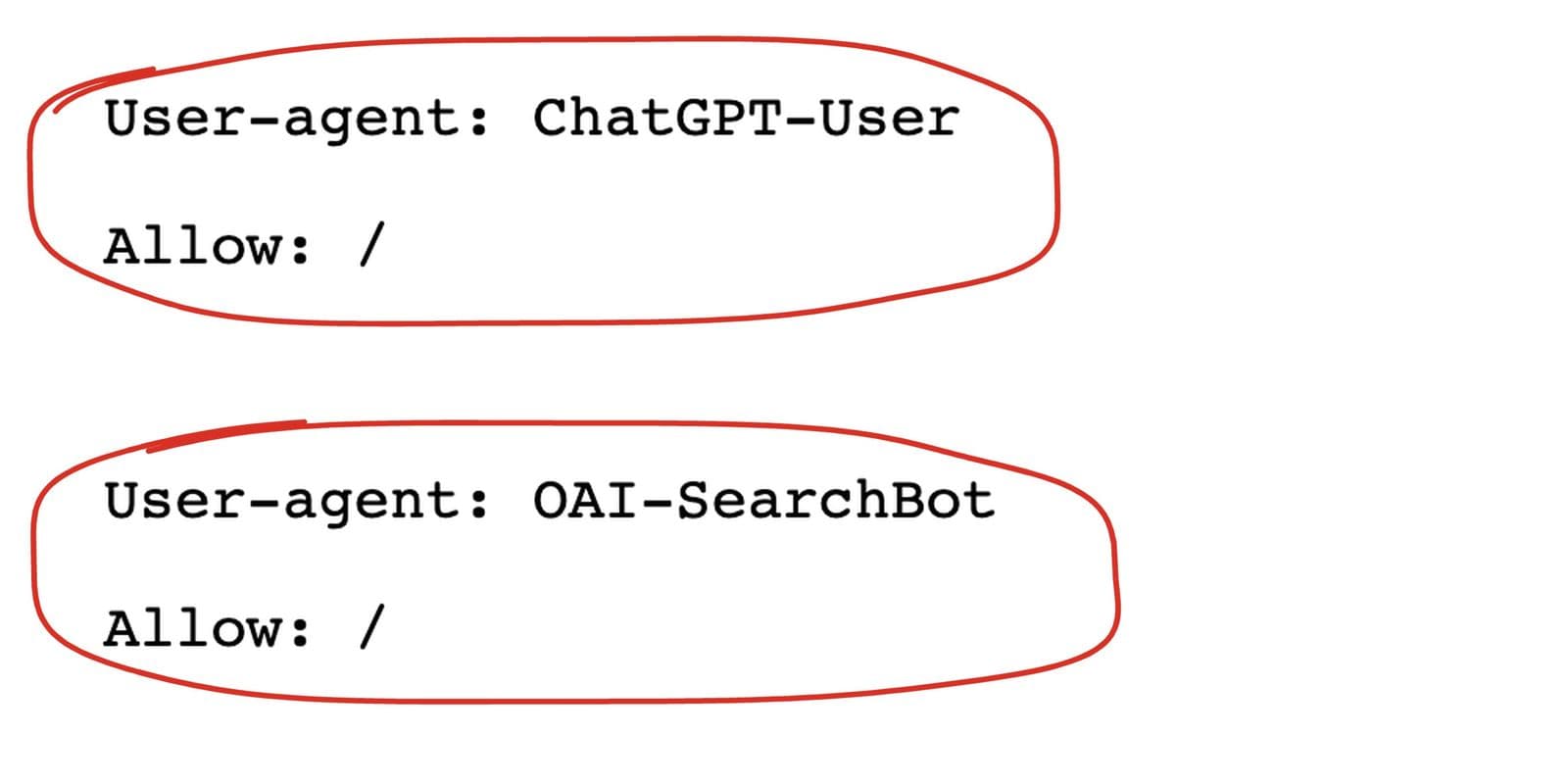 Two of the rules on my own site: ChatGPT-User (when ChatGPT opens a page for a user) and OAI-SearchBot (ChatGPT search).
This is part of the AI readiness category in my technical SEO checklist.
2. Get onto the lists AI reads
Since AI answers lean on third-party sites, I'm putting the same details on the ones that showed up in my measurements, under one name, one description and one set of contact details:
- Google Business Profile, verified in September, with five Google reviews so far, all five stars.
- Upwork, public since September.
- Clutch, submitted in September and under review.
- Greek directories Vrisko and XO, live since October.
- Bing Places and Apple Business, pending.
Consistency matters as much as presence. My name is shared with other people online, and an AI that finds two versions of me can mix them up or leave me out.
3. Write pages that answer one question with proof
The pages that got cited had a specific answer and real numbers behind it. So every article I publish now opens with a direct answer, shows a real project, and links every figure to its source. That's also the format this article is in.
4. Measure the same questions again
I'll re-run the same question sets eight weeks after this article goes live and add the result here, whatever it is. If the "best of" answers still don't mention me after the listings are live, the listings weren't the constraint and I'll say so.
Is SEO dead now with AI?
No, and ChatGPT SEO isn't a separate discipline either. AI search engines still read web pages to answer, and the pages they read are the ones search engines can crawl and understand. What changed is where the click goes: more questions get answered without one, and on "who should I hire" questions the answer leans on directories and review sites. Good SEO now includes being present and consistent on those.
FAQ
How do I get ChatGPT to recommend my business?
Allow OpenAI's search crawler in robots.txt, keep your name and details identical on Google Business Profile and the directories and marketplaces in your field, collect reviews, and publish pages that answer specific questions with real evidence. Then measure how often you're mentioned across repeated runs of the same questions.
How to do SEO for ChatGPT?
Start with technical access (robots.txt allows OAI-SearchBot), then entity consistency across the sites AI reads, then content that answers one question directly, with sources. Classic SEO still matters, because ChatGPT search uses web results.
Does ChatGPT use Google rankings?
ChatGPT search has its own crawler, OAI-SearchBot, and builds answers from the web pages it can access. Pages that rank well on Google are often the same ones AI cites, because both reward crawlable, clear, well-sourced pages, but the two aren't the same list.
How long does it take to show up in ChatGPT answers?
I don't know yet, and I'd be wary of anyone who promises a timeframe. AI answers change from run to run, so the only reliable way to tell is to measure the same questions repeatedly over months.
What is generative engine optimization?
Generative engine optimization (GEO) is the work of getting a brand cited or mentioned in AI-generated answers from tools like ChatGPT, Perplexity and Google's AI. In practice it overlaps heavily with technical SEO, entity consistency and clear, sourced content.
Want to know where you stand?
I can run the same kind of measurement for your business: the questions your buyers ask, repeated across AI engines, with the sources that get cited instead of you. See what I've built on my portfolio, or send me a message with the three questions you'd most like to be the answer to.