AI for Hotels: What's Worth Setting Up in 2026, and in What Order
AI for hotels, from someone who builds it: guest messaging, direct bookings, reviews, pricing, operations and AI search, ranked by what pays off first.
Short answer
AI for hotels is a lot of different tools sold under one label. A guest messaging bot, a pricing engine, a review assistant and a kitchen order system have almost nothing in common, except that a vendor will call each of them "hotel AI". If you run an independent hotel, the useful question isn't whether to use AI. It's which job to hand over first.
I'm Panagiotis Karampetsos, a developer based in Heraklion, Crete, and hotels are most of my client work. As of 23 September 2026, AI chat widgets I set up are live on Aroma Suites, Casa di Terra Villa and Amoopi Nymfes. I also built the breakfast ordering system at Volta Stay in Crete. This guide covers the whole hotel, area by area, and says where I'd start.
Each area in one line
- Guest messaging: the best first step for most small hotels. Repeat questions go to the bot, everything else to a person.
- Direct bookings: AI helps at the edges. A slow site or a clumsy booking engine costs more bookings than any bot wins back.
- Reviews: let AI draft replies and sort feedback by theme. A person reads every reply before it goes out.
- Pricing signals: real tools exist, and they need clean data and enough volume. Most 10-room properties should wait.
- Operations: the biggest time savings I've seen came from plain workflow software, with little AI in it.
- Content: AI is good at drafts and translation and bad at facts. Every fact still comes from you.
- AI search visibility: no trick exists. A fast site, clear facts and consistent listings are what ChatGPT and Google's AI answers read.
Where AI in hospitality stands in 2026
The big consultancies write about AI in the hotel industry as a strategy question for chains. BCG's March 2026 report, AI-First Hotels, found that in its 2025 analysis fewer than 10% of hospitality companies surveyed could be called "future built". The same report cites the American Hotel & Lodging Association: 65% of North American hotels reported staffing shortages in 2025.
Two more lines from that report matter for a small property. BCG writes that 37% of travelers already use AI language models built into online travel sites to plan and book trips. It also puts 2024 digital direct bookings at $262 billion against $266 billion for OTAs, with OTA commissions of 15% to 30%.
Those numbers are about chains, but I think they make the case for AI in hospitality at the small end even better. Guests ask AI tools where to stay. Staff time is short. Every booking you move from an OTA to your own site keeps the commission in your pocket. You don't need an enterprise budget for any of that, just a sensible order.
1. Guest messaging
Of all the AI for hotels on the market, this is where I'd start, and it's the area I've built the most. A chat assistant on your website answers the questions your reception answers every day: check-in time, parking, transfers, breakfast, pets, how far the beach is. It answers in the guest's language, at 2am, and hands anything complicated to a person.
I wrote a separate, detailed guide to hotel chatbots covering costs, SaaS versus custom, and what broke when I put one on a live hotel site. I won't repeat it here. The two lessons that matter for this page:
- The bot only knows what you give it. It reads your website, room descriptions and policies. If your site says breakfast ends at 10:30 and reception says 11:00, the bot will be wrong in front of a guest.
- Every chat needs a way to reach a human. Refunds, complaints and changes to a booking go to a person in one step.
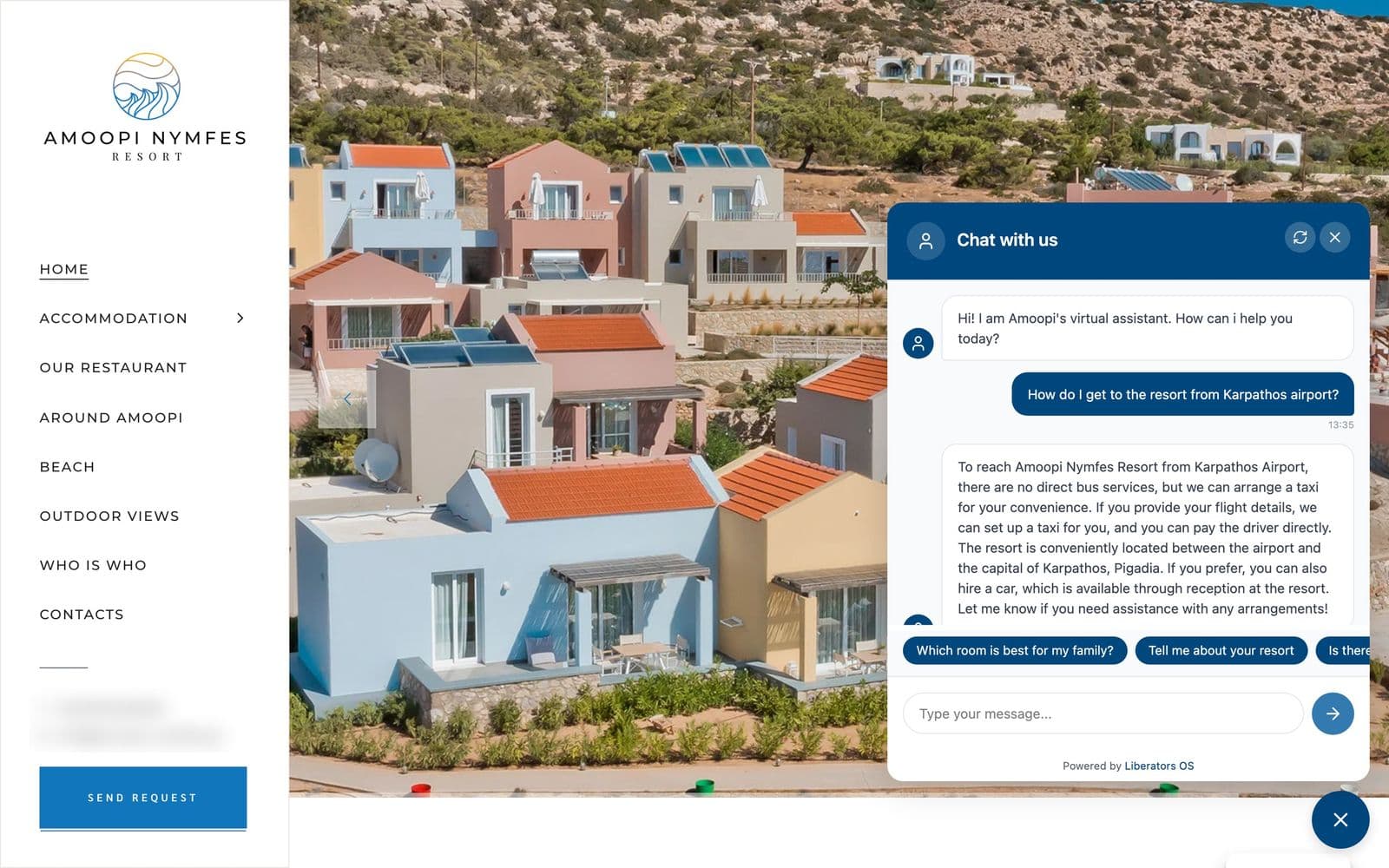 A transfer question, one of the repeat questions reception gets every day, answered from the resort's own information.
2. Direct bookings
I'll be blunt here: if your site is slow, no AI feature will fix your direct bookings.
On Aroma Suites the rate check sits inside the chat. A guest asks "do you have a room for two from 12 to 15 May?" in the chat, and the check happens right there. That's useful, because a guest who's already asking is close to booking.
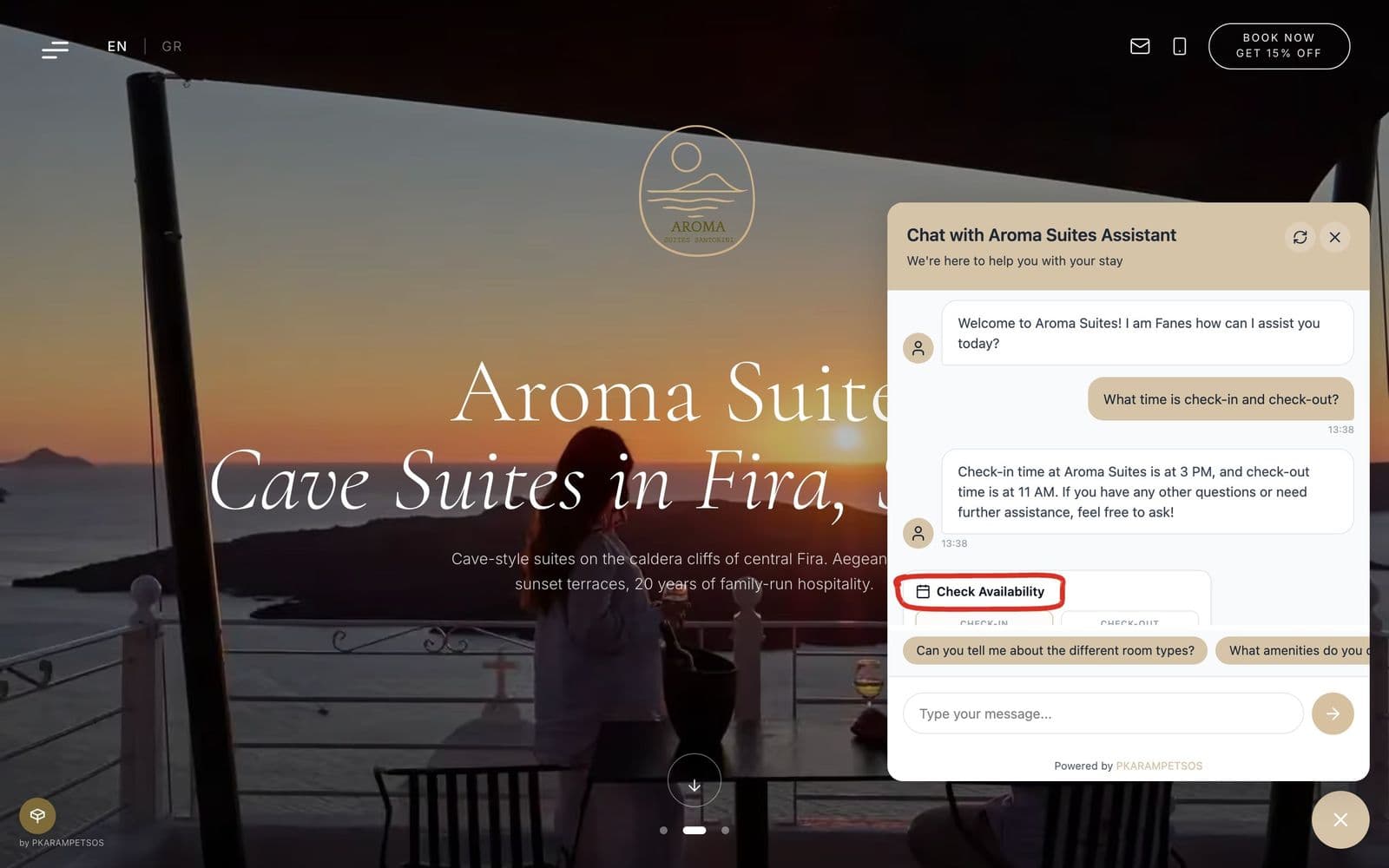 The circled availability check opens inside the same chat, under the answer, while the guest is still asking questions.
What decides most direct bookings is less exciting. The site has to load fast on a phone, the booking engine has to work without five steps of friction, and the direct price has to be at least as good as the one on the OTA. I've covered the website side and what it costs in my hotel website cost breakdown. Fix those first. Then add AI on top.
3. Reviews
Review replies are a good job for AI as long as a person reads every reply before it's posted. A language model can draft a reply in the guest's language, pick up the specific thing they mentioned, and keep a consistent tone across a busy season.
I'd never let it auto-post. A reply that thanks a guest for a "lovely stay" under a complaint about a broken air conditioner is worse than no reply at all.
The part owners skip is using AI to read. Paste a month of reviews into a model and ask it to group the complaints by theme. Noise, a weak shower, a slow check-in: recurring problems show up much faster than when you read reviews one at a time.
And never use AI to write reviews. That isn't a grey area.
4. Pricing signals
AI revenue management tools read demand, competitor rates and your booking pace, then suggest or set prices. For a chain, that's established practice.
For a small independent hotel, I'd be more careful. I haven't built a pricing engine, so this is the checklist I'd run before buying one, not a report from the inside:
- Do you have enough data? A tool learns from your booking history. A 10-room property with one season of clean data gives it little to work with.
- Does it connect to your channel manager? If it can't push rates automatically, you're paying for suggestions you'll copy by hand.
- Can you set limits? Keep a floor and a ceiling you decide yourself.
Many small hotels get most of the value from watching competitor rates and local events, then deciding for themselves.
5. Operations: the breakfast example
The most useful system I built for a hotel this year has almost no AI in it.
At Volta Stay in Crete, breakfast is delivered to the suites. A guest scans a QR code in the suite, picks their suite from a list and chooses breakfast for the next morning from the menu, with a note field for allergies and requests. The kitchen gets each order on Viber, a daily summary, and a printable PDF of the whole morning, grouped by room. The kitchen side is in Greek, straight from the owner's own menu file, while the guest side is in English.
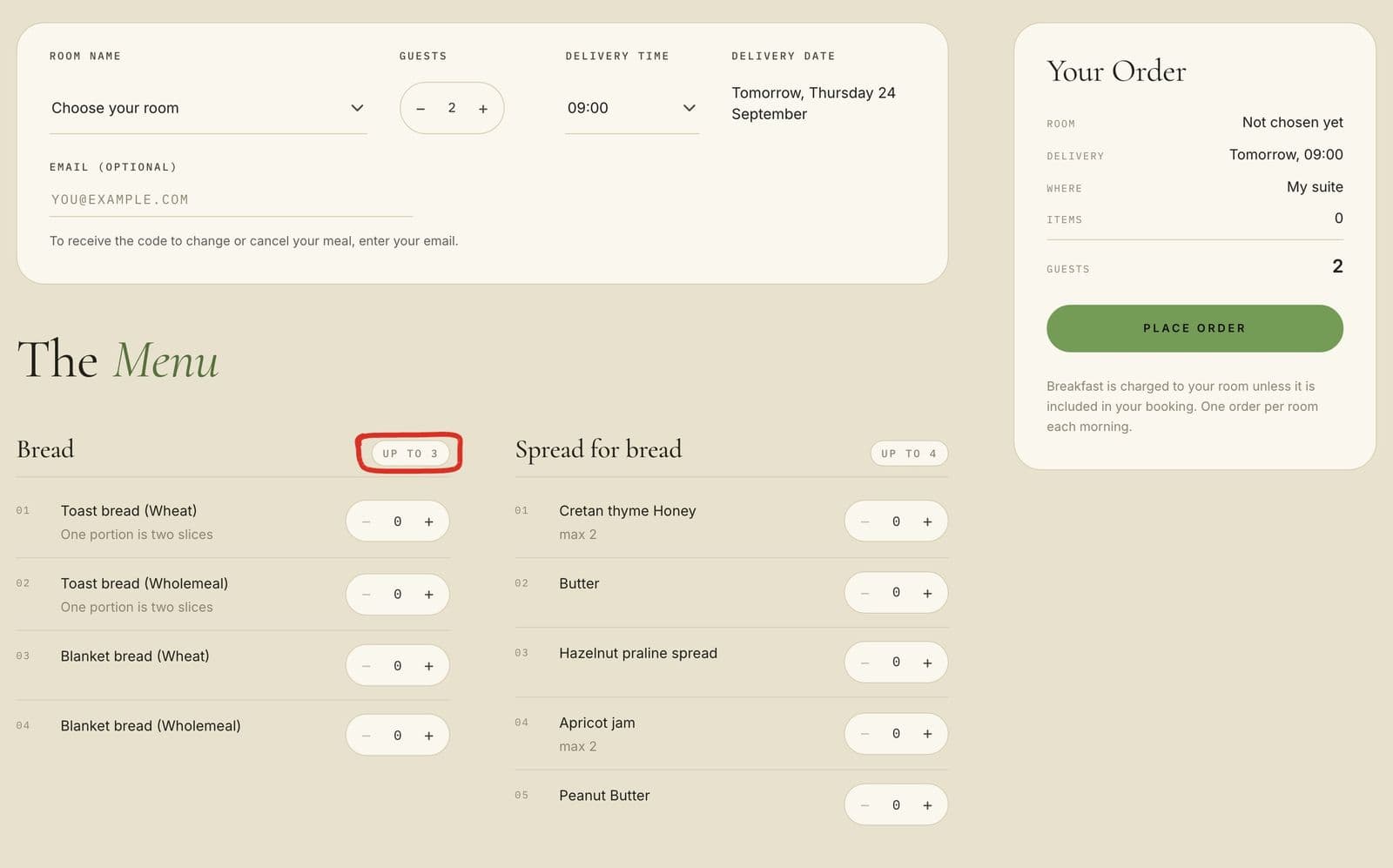 The guest side of the breakfast system. Every choice is fixed, down to the circled limit per section, which is why this part needs plain software and not AI.
That's where a lot of the time goes in a small hotel: housekeeping lists, maintenance requests, breakfast, transfers, handovers between shifts. Some of these need AI, like summarising guest notes or reading a supplier's PDF. Most need a clear form, the right notification and a report someone reads. Build the plain workflow first, then add AI where a person is still copying text by hand.
6. Content
AI is fast at first drafts, translations and variations, and hotels need a lot of all three: room descriptions in several languages, area guides, seasonal offers, email replies.
What it can't do is know your hotel. It'll guess a distance, name a restaurant that closed last year, or call a sea view "panoramic" when it's partial. On the sites I work on, the facts come from the owner and the draft comes from the model, never the other way round.
One more check before you write any blog post, with AI or without: make sure people search for the topic and that a small hotel can realistically rank for it. A post nobody finds still costs you the hours it took to write.
7. AI search visibility
This is the newest area and the one with the most noise. Guests now ask ChatGPT, Perplexity and Google's AI answers for hotel recommendations. How do you show up?
Google's own documentation is plain about it: "There are no additional requirements to appear in AI Overviews or AI Mode, nor other special optimizations necessary" (Google Search Central, updated 10 December 2025). What helps is the same groundwork that helps normal search: a fast, crawlable site, structured data, and the same name, address, phone and facts on your website, Google Business Profile, OTAs and directories.
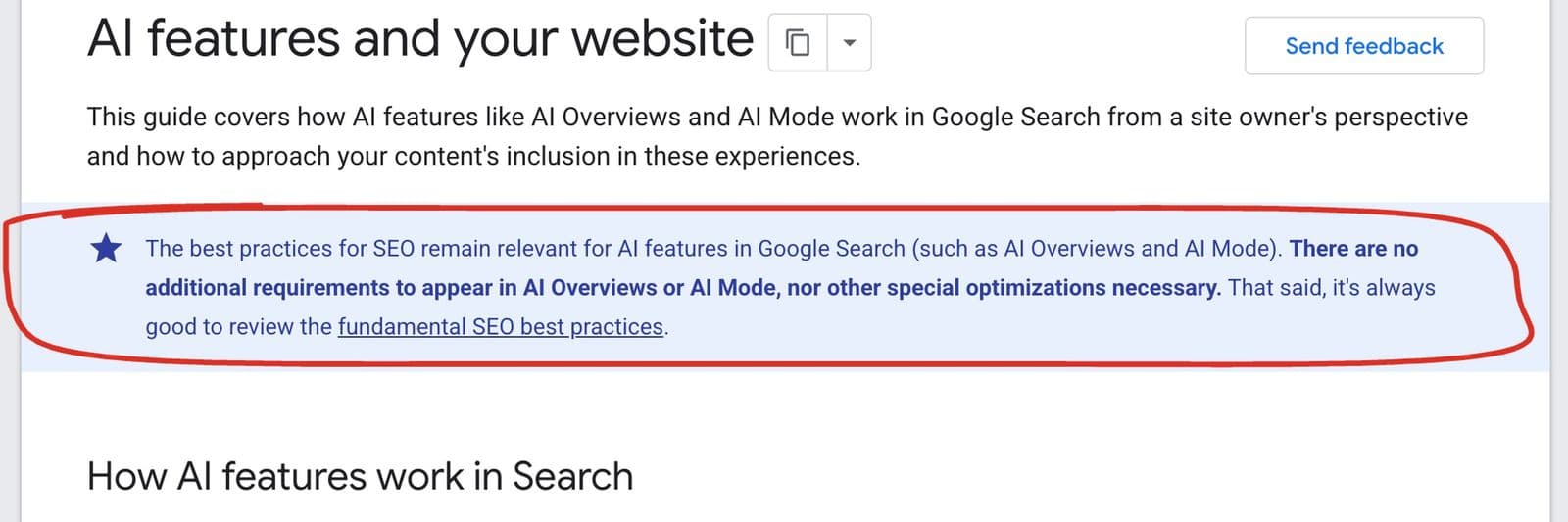 The note at the top of Google's AI features page, as it read on 6 October 2026. Anyone selling a special "AI Overviews package" is selling something Google says you don't need.
When I rebuilt Aroma Suites with that groundwork in place, Google Analytics recorded 537 organic sessions in the first three weeks after launch (28 March to 18 April 2026). The details of how I approach it are on my hotel SEO page.
One warning about measurement. AI answers change from one ask to the next. If you check once whether ChatGPT mentions your hotel, you've learned almost nothing. Ask the same question several times and count how often you appear.
AI for hotels: what I'd set up first
| Area | Effort | When it pays off | Skip it if |
|---|---|---|---|
| Guest messaging | Low to medium | First season | Your site content is thin or out of date. Fix that first |
| Direct booking basics | Medium | First season | Never skip. This is the foundation |
| Review replies and themes | Low | Right away | You get only a handful of reviews a year |
| Operations workflows | Medium | Within weeks | Your team is two people who already talk all day |
| Content drafts and translation | Low | Right away | Nobody has time to check the facts |
| AI search groundwork | Medium | Months | Never skip. It's the same work as SEO |
| Pricing tools | Medium to high | Depends on data | You have under a year of clean booking data |
What to watch out for
Label the bot. Article 50 of the EU AI Act applies from 2 August 2026. It requires that people are informed they're interacting with an AI system (Article 50, EU AI Act). If you have guests from the EU, say so in the chat window.
Know where guest data goes, too. A chat tool sees names, dates and sometimes passport or payment questions. Ask the vendor where conversations are stored and for how long, and don't paste guest data into a free chatbot.
Every tool you add puts more code on your site. Chat widgets and tracking scripts slow pages down and can break when a vendor changes something on their side. Test your site's speed before and after.
And don't let AI invent facts. Hours, prices, distances and policies come from you, and the model writes around them.
FAQ
What is the best AI tool for hotels?
There isn't one best tool, because "AI for hotels" covers different jobs. For most independent hotels the best first tool is a guest messaging assistant that reads your own website and hands off to staff. Pricing and operations tools come later.
How can AI be used in hotels?
The main uses are guest messaging, booking support, review replies and review analysis, pricing suggestions, operational workflows, content drafts and translation, and preparing a hotel to show up in AI search answers. Each is a separate tool or system.
Will AI replace hotel staff?
Not in a small hotel. AI takes the repeat questions and the copying between systems, so reception and the kitchen spend less time on them. Complaints, refunds and anything that needs judgement stay with people.
How much does AI for a small hotel cost?
It depends on the area. Chat tools are usually a monthly subscription, and I list current SaaS prices in my hotel chatbot guide. Custom systems like the Volta Stay breakfast ordering are a one-off build priced after a look at the workflow.
Do I have to tell guests they're talking to AI?
In the EU, yes. Article 50 of the AI Act applies from 2 August 2026 and requires that people are informed they're interacting with an AI system. A clear label in the chat window covers it.
Can AI help my hotel show up in ChatGPT?
Indirectly. AI assistants lean on what's already on the web about you: your site, your Google Business Profile, OTA listings and reviews. Google says no special optimization is needed for its AI answers. Consistent facts, a fast site and structured data do the work.
Where to start
The best AI for hotels is the one that takes over the job costing your team the most time this season. Pick that area first. For most small hotels that's guest questions, for some it's breakfast or housekeeping. Fix that one properly before adding the next.
If you want a second opinion on where AI fits in your hotel, send me a message and tell me what takes up your team's week. You can see the hotel sites and systems I've built in my portfolio.